
At some point, most credit union leadership teams have the same conversation: the technology stack feels dated, members expect more from digital channels, and something has to change. The question is what.
Full core replacement is one answer. It’s also a significant undertaking, involving data migration, staff retraining, rebuilt integrations, and member-facing disruption, all carrying a price tag and a timeline that stretch across years. For many credit unions, the core itself isn’t what’s holding them back. The gaps are in the processes and tools built around it.
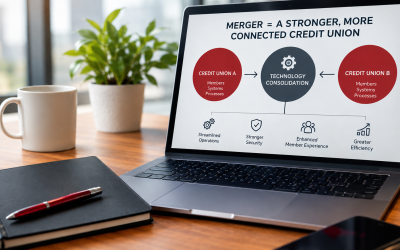
The more practical path for most institutions is to modernize through integration rather than replacement.
The Real Source of Operational Friction
Credit union technology problems tend to concentrate at connection points, which are the places where data moves from one system to another, or where a member or staff action should trigger an automated response but doesn’t.
A member submits a loan application online, and a staff member manually enters it into the system. A member wants to add a joint owner to their account and has to come into a branch because there’s no self-service option connected to the core. Back-office processes run through custom scripts that require development resources to maintain. Each of these is a friction point, and none of them require replacing the core to fix.
What they require is a direct connection between the process and the core, a tool that operates as an extension of what’s already there rather than a parallel system that has to stay synchronized with it.
What Integration-First Modernization Looks Like
IMSI’s approach to credit union technology has been consistent since 2007: build solutions that integrate directly with the core, not alongside it. The distinction matters operationally. A solution that connects to the core’s data layer and writes records in real time behaves like a native part of the platform. A solution that collects data separately and syncs it later introduces the same manual dependencies it was supposed to eliminate.
On Corelation KeyStone, this means solutions that use the KeyStone API to read and write data directly, respect user privileges and API business logic, and reflect changes immediately across every connected workflow.
On Symitar Episys, it means the same principle applied to the Episys core: real-time integration rather than periodic data exchange.
Targeted Improvements Across the Operation
Modernization through integration doesn’t happen all at once, and it doesn’t need to. The process is incremental: identify where the operational gaps are, and build a solution that closes each one directly.
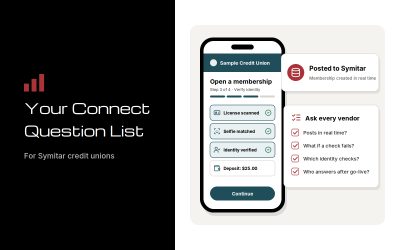
For account opening, IMSI’s Online Account Opening solution automates decisioning and writes new account records to the core in real time, eliminating the manual steps between application submission and account creation. The member gets an immediate response. Staff don’t touch it.
For back-office operations on KeyStone, Infuzion gives credit union teams the ability to run mass table updates, SQL queries to KeyBridge, and batch file processing through the KeyStone API — without batch scripting or Java development. Back-office tasks that previously required development resources to maintain now run through easy-to-modify scripts on a scheduled basis.
For member-facing self-service, solutions like Member Info Updater, Skip-a-Pay, and Add Joint Owner connect directly to the core, so members can complete account tasks online without staff involvement. The core reflects every change in real time.
The Compounding Value of Connected Solutions
Each individual solution improves one process. When multiple solutions connect to the same core, the effect compounds. Member data stays consistent because updates write to the core directly. Staff time shifts away from data entry and routine maintenance. Member interactions that used to require a branch visit or a phone call now complete through self-service channels that deliver real-time results.
Credit unions don’t need to replace their technology to reach that outcome. They need the tools surrounding their core to actually connect to it.
Assessing Where to Start
The most useful question for any credit union evaluating its technology isn’t whether the core is current enough. It’s whether the processes built around the core are connected to it — or whether staff are still manually bridging gaps that should run automatically.
IMS Integration works with credit unions on Corelation KeyStone and Symitar Episys to identify those gaps and build solutions around them. Contact us to schedule a conversation about your current setup.