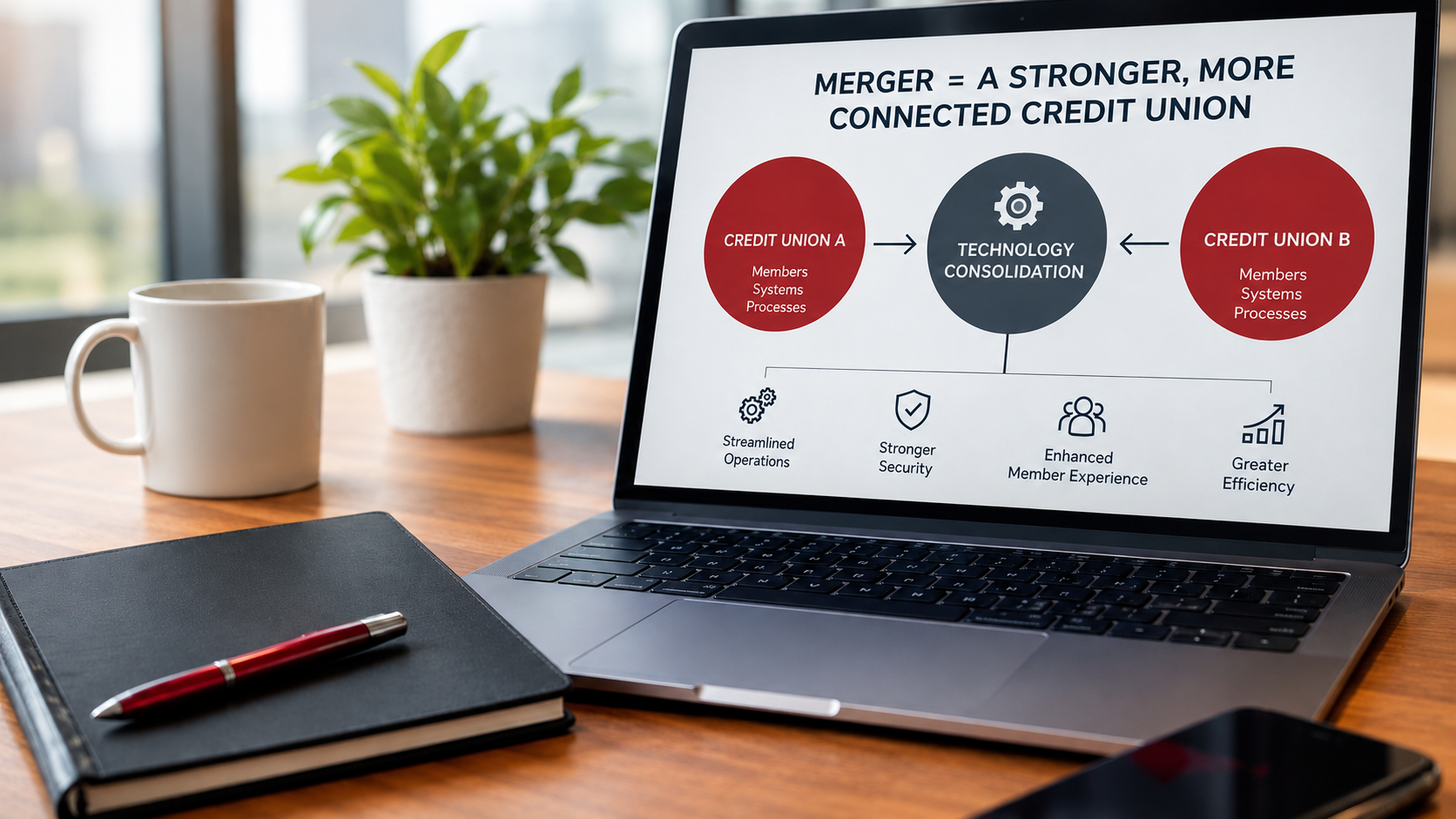
A credit union merger may be approved on paper long before the technology feels like one institution. Behind the member notices, new signage, and organizational changes are two operating environments that were built independently: two sets of applications, contracts, integrations, user permissions, data conventions, digital experiences, and staff workarounds.
That overlap is temporary, but it can become expensive and risky if it is allowed to linger. Staff may work in parallel systems. Member information may exist in multiple places. Vendors may provide similar functionality under different contracts. A process that was already manual at one credit union can become even more complicated when it has to cross into the other institution’s systems.
Technology consolidation is the work of turning those two environments into one operating model. It is not simply a cost-cutting exercise and it is not a checklist of applications to cancel. The decisions made during consolidation determine how efficiently the combined credit union will operate, how consistently members will be served, and how much technical debt the organization carries into the next phase of growth.
For credit unions, the core system is usually the natural anchor. Nearly every important workflow eventually touches member data, account records, lending activity, payments, documents, or transactions that live in the core. That means the strongest consolidation strategy starts by defining the future core environment and then making sure the tools around it connect cleanly, securely, and intentionally.
The objective is straightforward: one credit union should eventually operate like one credit union. Getting there requires a disciplined approach to systems, data, vendors, workflows, security, and change management.
Technology Consolidation Starts Before the Conversion Weekend
The visible conversion date is only one milestone in a much longer technology program. By the time member-facing systems change, leadership should already know which applications will remain, which will be replaced, which contracts must be exited, how data will be mapped, which integrations have to be rebuilt, and what the fallback plan looks like if a critical step does not work as expected.
NCUA merger resources focus heavily on the formal merger process, but the agency’s broader lessons on mergers also emphasize determining needed technology changes, training staff, and maintaining sound internal controls. Those are not separate concerns. Technology choices affect staff readiness, operational control, and the member experience at the same time.
The most common mistake is to treat technology as a late-stage implementation task. If the combined institution waits until after organizational decisions are made to examine system dependencies, it may discover that a product slated for retirement is feeding data to several other tools, supporting a branch workflow, or carrying a contract obligation that extends well beyond the merger date.
A better approach is to make technology consolidation a merger workstream from the beginning. The goal is not to finalize every technical detail immediately. It is to expose dependencies early enough that leadership can make informed decisions instead of discovering them during cutover.
Start With an Inventory, Not a Winner-and-Loser List
Two technology stacks can look similar at the product-name level and behave very differently in practice. Both credit unions may have an online account opening platform, a document system, an online banking provider, a loan origination system, and a payment tool. That does not mean those systems serve the same workflows, connect to the core in the same way, or create the same staff workload.
Before deciding which system survives, document what each one actually does. For every major application, capture the business owner, users, data exchanged, upstream and downstream dependencies, authentication method, vendor contract term, support model, integration method, manual steps, and member-facing impact.
This is where many consolidation opportunities become obvious. A product that appears redundant may support a unique workflow that has to be rebuilt before it can be retired. Two separate vendors may provide overlapping capabilities, but one may be tightly integrated while the other depends on file transfers and staff re-entry. A homegrown script may look insignificant until the team realizes it performs a nightly update required by another system.
The inventory should also identify shadow processes: spreadsheets, email approvals, recurring exports, manual reconciliations, and staff shortcuts that sit between formal systems. Those are part of the technology environment whether they appear on the vendor list or not.
Define the Target Operating Model Before You Consolidate Tools
A merger creates an opportunity to choose how the combined credit union should operate rather than simply preserving whichever process belongs to the continuing institution. That distinction matters.
If leadership decides only which system remains, staff may inherit the same inefficiencies under a larger organization. The better question is: What should this workflow look like after the merger? Which steps should be automated? Which information should come directly from the core? Where should staff intervene? What should members be able to complete through self-service? Which system should be the authoritative source for each type of data?
Those questions create the target operating model. Once that model is clear, system decisions become easier because each application can be evaluated against the future process rather than against familiarity or internal preference.
This is especially useful when the two credit unions have different strengths. One institution may have the better digital account opening experience while the other has cleaner back-office automation. The final model does not have to replicate either environment exactly. It can combine the strongest operating practices and remove unnecessary manual work from both.
Use the Core as the Anchor for the Consolidated Environment
For most credit unions, core selection is the most consequential technology decision in a merger because so many other systems depend on it. Once the continuing core is established, every surrounding workflow should be evaluated based on how well it connects to that environment.
This is where integration depth matters. A system that looks modern on the front end can still create operational friction if staff must re-enter data, wait for periodic synchronization, manually create records, or reconcile discrepancies between the application and the core.
IMSI’s integration-first approach is built around the opposite model: solutions operate as extensions of the core, reading and writing data directly so the core remains the system of record. On Corelation KeyStone and Symitar Episys, that principle helps credit unions reduce the number of parallel data stores and manual handoffs surrounding member-facing and back-office processes.
During a merger, that architecture can simplify the long-term environment. Once the target core is known, the credit union can ask a practical question about every connected application: Does this tool strengthen the core environment, or does it create another system staff have to keep in sync?
Not every application has to be native to the core, and third-party platforms will remain part of the technology stack. The important point is that data movement and workflow ownership should be intentional. The combined credit union should know where information originates, which system owns it, how it moves, and what happens when an integration fails.
Consolidate Workflows, Not Just Vendor Contracts
Vendor rationalization is often one of the first financial opportunities identified in a merger. If two credit unions pay for similar platforms, eliminating the duplicate appears straightforward. But canceling a contract does not eliminate the process the system supported.
Every retirement decision should therefore include a workflow migration plan. If a legacy tool handled skip-a-pay requests, online account opening, document delivery, member information changes, loan payments, or internal approvals, the surviving environment has to absorb those functions before the old system disappears.
This is where direct integration can produce more value than simple product consolidation. When a workflow connects to the core in real time, the credit union can often remove manual data entry and reconciliation at the same time it removes a duplicate vendor. The organization does not merely reduce the number of systems; it improves the process.
The reverse is also true. Replacing a well-integrated workflow with a product that requires more manual handling may reduce the vendor count while increasing staff workload. Technology consolidation should be measured by operational outcomes, not by the number of contracts terminated.
Treat Data Migration as a Business Process, Not a File Transfer
A merger can expose years of differences in how two institutions structure and maintain data. The same concept may use different codes, naming conventions, product definitions, document categories, or status values. Duplicate members may appear across systems. Addresses may be formatted differently. Historical data may not map cleanly to the continuing environment.
Moving that information is not enough. The credit union has to decide what the data means in the new environment and how it should behave after conversion.
A disciplined migration process includes mapping, cleansing, deduplication, validation, exception handling, reconciliation, and repeated testing. Business owners should be involved because technical teams can confirm that a value moved successfully without necessarily knowing whether it landed in the correct operational context.
The same principle applies to integrations. If an application depends on a member type, loan code, share type, document category, or field that changes during conversion, the interface may continue to run while producing the wrong result. Testing has to confirm business outcomes, not just connectivity.
The cleanest consolidation projects use the merger as an opportunity to improve data quality rather than carrying every inconsistency forward. That may mean standardizing fields, eliminating obsolete codes, validating member information, and documenting ownership rules before the combined environment goes live.
Where Merger Technology Risk Usually Hides
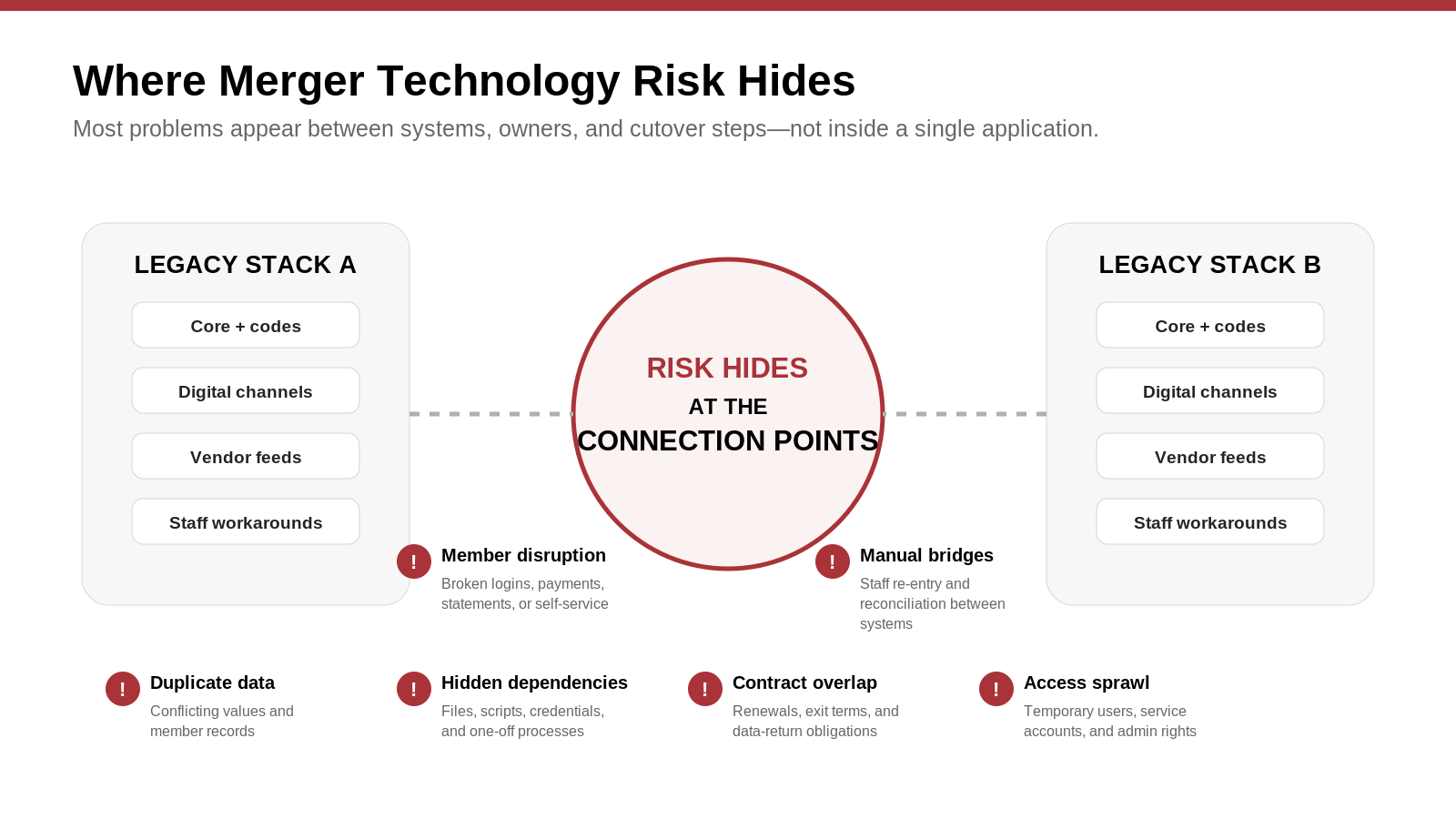
The highest-risk issues are not always the largest systems. Risk often sits at the connection points between them: a nightly file that no one documented, an integration credential tied to a departing employee, a vendor that receives member data through an older transfer method, a workflow that only one branch understands, or a contract that auto-renews during the conversion period.
Security and third-party risk deserve particular attention. NCUA guidance makes clear that credit unions remain responsible for vendor due diligence, contract oversight, cybersecurity considerations, and ongoing monitoring of outsourced services. A merger increases the number of vendors and access relationships that need to be understood before they can be reduced.
Identity and access management can also become complicated quickly. Employees may need temporary access to both environments. Duplicate accounts can remain active longer than intended. Shared credentials, service accounts, API keys, and administrative rights may not follow the same standards at both institutions.
The consolidation plan should therefore include access cleanup, credential ownership, privileged-access review, vendor connection review, logging, and clear decommissioning steps for retired systems. Technology retirement is not complete until data access, integrations, credentials, and contractual obligations have been closed out appropriately.
Sequence the Work Around Member Impact and Operational Risk
Not every system should change at once. A merger already creates significant organizational change, and forcing every technology conversion into the same window can create avoidable risk for staff and members.
A better sequence separates foundational decisions from later optimization. The core, identity infrastructure, critical integrations, digital access, payments, and other high-dependency systems usually require early planning because so many processes rely on them. Lower-risk tools can follow once the combined institution is stable.
Some duplicate systems may need to coexist temporarily. That is acceptable when the overlap is intentional, time-limited, and supported by a clear transition plan. The problem is unplanned coexistence, where two systems remain in place because no one owns the retirement work.
For each phase, define the entry criteria, testing approach, staff training, member communication, cutover steps, contingency plan, and completion criteria. A system should not be considered consolidated simply because the new platform is live. The old process has to be retired, the data reconciled, access removed, and staff behavior transitioned as well.
Protect the Member Experience During Consolidation
Members do not care which institution’s technology was selected. They care whether they can log in, make a payment, apply for a loan, find a statement, open an account, update information, and get help without unnecessary friction.
That makes member journeys a useful way to test consolidation decisions. Instead of validating only individual systems, test the end-to-end experience: What happens when a member changes an address? Does the new information reach every place it should? Can a member begin a process online and have staff see the same information? Are disclosures and documents available in the right channel? Does a payment post correctly to the core?
Merger communications are important, but good communication cannot compensate for a broken workflow. The best member experience is one where the underlying systems are coordinated well enough that members do not have to understand the technology transition.
This is also where self-service deserves attention. A larger combined credit union often serves a broader membership and more locations. Processes that depended on a familiar branch relationship may not scale well after the merger. Expanding secure digital self-service can reduce pressure on staff while giving members a consistent way to complete routine tasks across the expanded organization.
Consolidate Vendors With Both Cost and Capability in Mind
A merger creates leverage to review the vendor portfolio, but the lowest-cost option is not automatically the best consolidated choice. Leadership should evaluate each provider based on total operational impact: integration quality, reliability, support responsiveness, security posture, configurability, staff effort, member experience, contract flexibility, and the cost of replacing existing workflows.
Contract timing matters too. Termination provisions, renewal dates, data-return requirements, implementation fees, and notice periods can affect the sequence of consolidation. A product that leadership intends to retire may still need to operate for several months while data is exported, replacement workflows are configured, and staff are trained.
The merger is also a good time to challenge unnecessary complexity. If several vendors exist because each solves a narrow gap created by disconnected systems, a more integrated solution may remove multiple dependencies at once. That is different from simply choosing one of two duplicate vendors. It is redesigning the stack around fewer handoffs.
Give Staff a Clear Post-Merger Workflow
Technology consolidation fails when the system changes but the work does not. Staff may continue using old spreadsheets, manual checks, or legacy workarounds because those processes are familiar and the new workflow was never clearly defined.
Training should therefore focus on the complete process, not only the new screen. Employees need to know what changed, what disappeared, what is now automated, when an exception requires intervention, where to find information, and who owns a problem when something does not work.
This is especially important for frontline and back-office teams that absorb merger complexity first. If systems are not integrated cleanly, staff become the integration layer. They copy data, explain inconsistencies, work around duplicate records, and translate between old and new procedures.
A well-designed consolidated environment removes that burden. Staff attention shifts toward exceptions, complex member needs, and higher-value work instead of maintaining connections that technology should handle automatically.
Measure Success by the Operating Environment You End Up With
The merger date is not the finish line for technology consolidation. The combined credit union should evaluate whether the new environment actually delivers the outcomes that justified the work.
* Fewer duplicate applications and contracts.
* Less manual entry between member-facing systems and the core.
* Fewer reconciliation points and conflicting records.
* Consistent member experiences across branches and digital channels.
* Clear ownership of data, integrations, vendors, and workflows.
* Lower exception volume for routine processes.
* Retired systems with access, data, and contracts fully closed out.
* Staff who understand the new process rather than relying on legacy workarounds.
Those measures reveal whether consolidation created one operating environment or simply placed two technology stacks under the same organizational name.
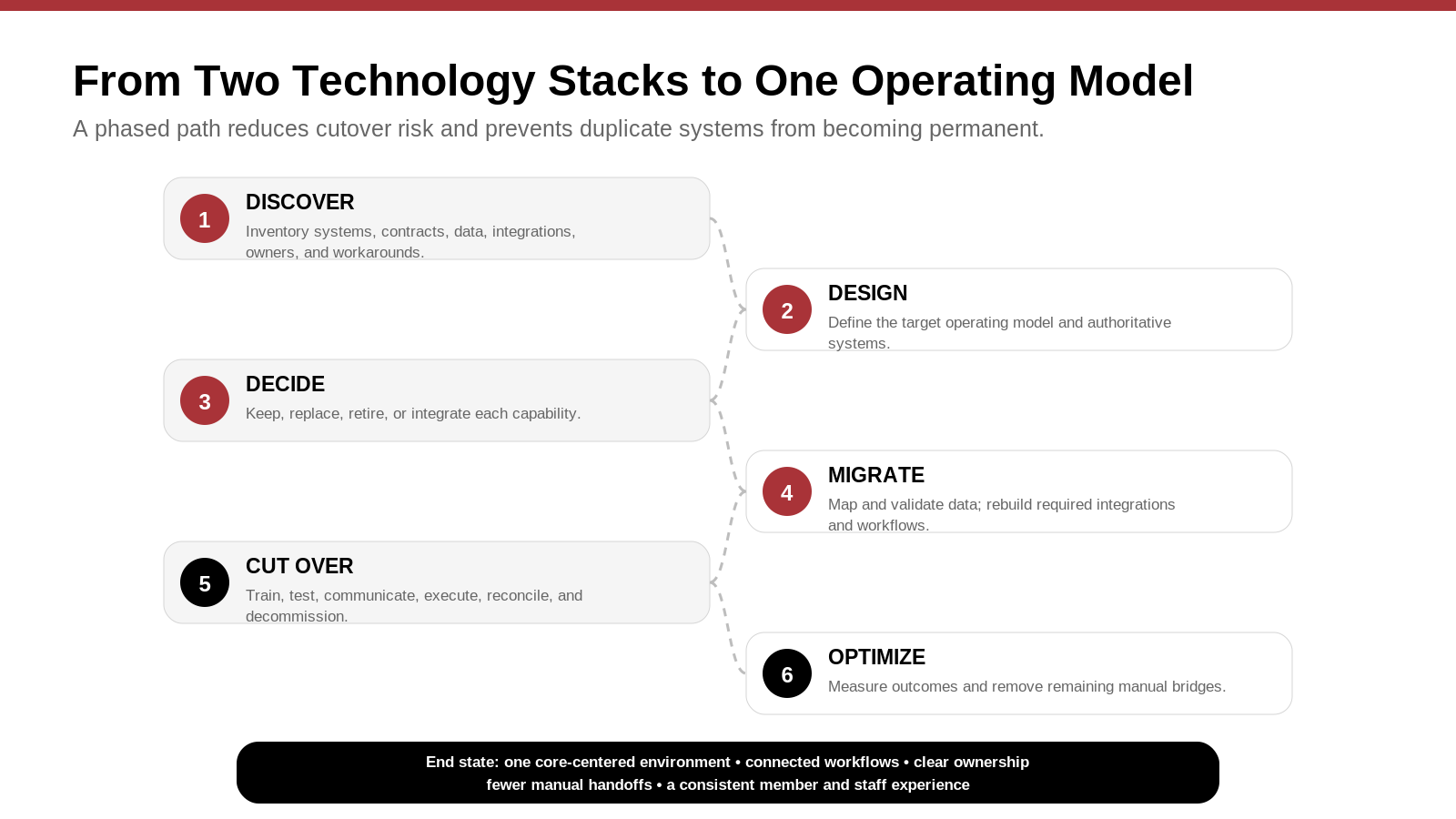
What Integration-First Consolidation Looks Like for KeyStone and Episys Credit Unions
For credit unions consolidating onto Corelation KeyStone or Symitar Episys, the post-merger technology strategy should consider how surrounding solutions connect to the core from the beginning. A member-facing tool that writes directly to the core, applies the credit union’s workflow logic, and returns a real-time result is fundamentally different from a standalone application that creates another queue for staff to manage.
IMSI develops customized credit union solutions around that direct-integration model. Depending on the core and the workflow, that can include member-facing processes such as Online Account Opening, Skip-a-Pay, Loan Pay, and other tools, as well as back-office workflows designed to reduce manual intervention.
The value during a merger is not that one vendor solves every conversion challenge. It is that the continuing credit union has an opportunity to rebuild important workflows around the future core instead of preserving disconnected processes from both legacy institutions.
That approach supports a simpler operating model: one system of record, connected workflows, fewer manual bridges, and technology that reflects the policies and processes of the combined credit union.
One Credit Union Should Eventually Feel Like One Credit Union
A successful merger does more than combine balance sheets and member bases. It creates an institution that can operate consistently at a larger scale.
Technology consolidation is central to that outcome because systems define so much of the daily experience for members and employees. If two cores, duplicate vendors, separate data definitions, disconnected workflows, and old workarounds remain in place indefinitely, the organization may be legally combined while operations are still divided.
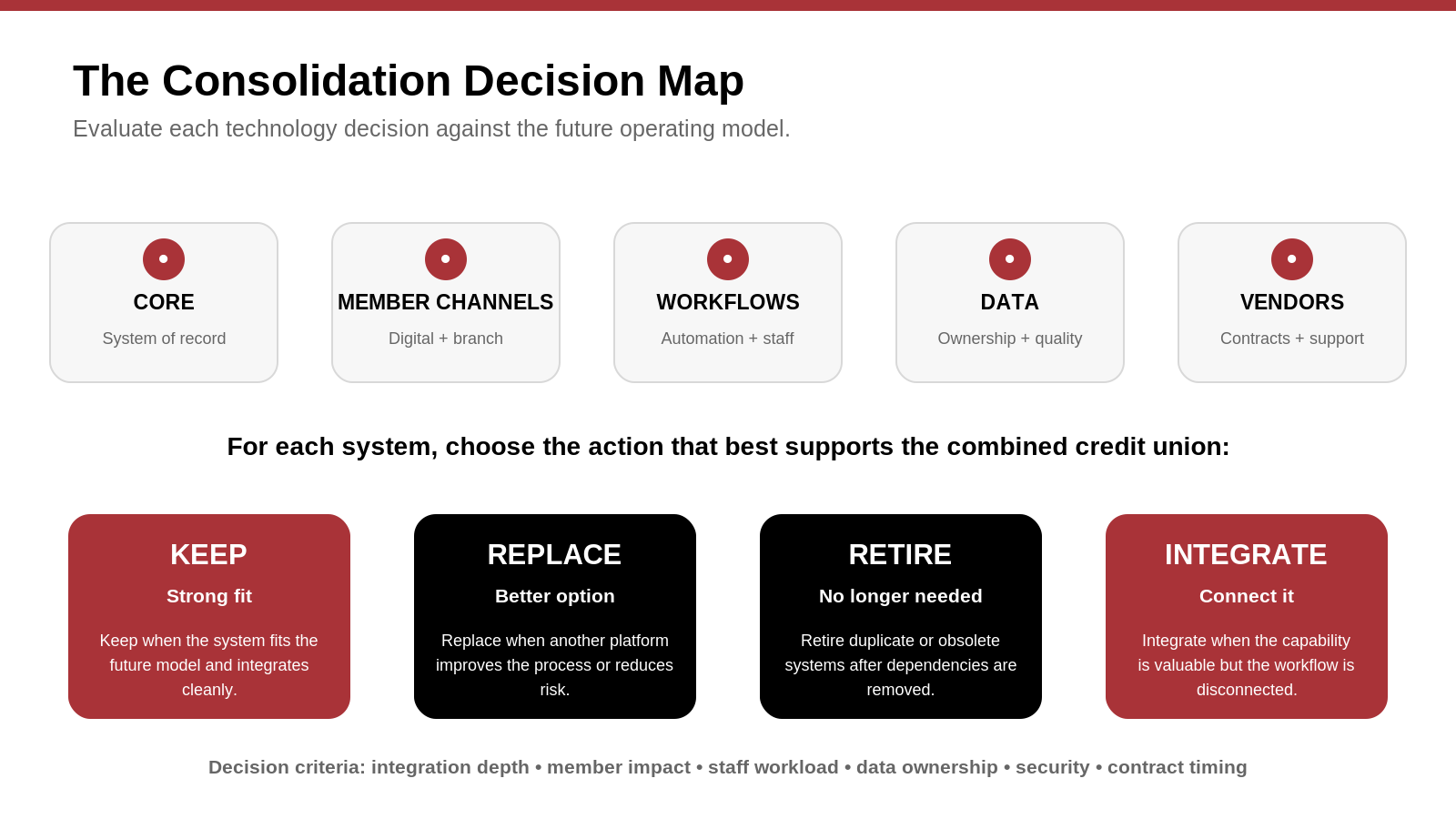
The better objective is not maximum standardization at any cost. It is intentional simplification. Keep the systems and processes that support the future operating model. Replace the ones that create unnecessary friction. Retire what no longer adds value. Integrate the workflows that should behave as one process.
For credit unions on Corelation KeyStone or Symitar Episys, IMS Integration can help evaluate the workflows surrounding the core and identify opportunities to reduce manual work, strengthen self-service, and create a more connected post-merger environment.
If your credit union is planning a merger or working through post-merger technology consolidation, schedule a strategy call with IMSI to discuss where direct core integration can simplify the combined operation.