
Digital account opening has changed the way credit unions attract and onboard new members. A prospective member no longer needs to visit a branch, wait for a representative, or complete a paper application. They can begin the process from a phone or computer, often at any hour of the day.
That convenience is exactly what members expect. It is also what makes digital account opening attractive to fraudsters. The application is remote, the interaction can happen quickly, and the credit union may never see the applicant face to face.
That does not mean digital account opening has to be less secure. It means the security model has to be designed for a digital environment.
The strongest approach is not to depend on one fraud check to decide whether an application is legitimate. It is to build multiple controls into the workflow so identity, eligibility, location, application data, documents, risk signals, and staff review can support one another.
That is the idea behind layered fraud prevention. FFIEC guidance on authentication and access describes layered security as multiple preventative, detective, and corrective controls designed to compensate for potential weaknesses in any one control. For a credit union, that same principle translates naturally to digital onboarding: no single checkpoint has to carry the entire fraud decision.
The goal is not simply to add more security steps. The goal is to make suspicious applications harder to advance while allowing legitimate prospective members to complete the process with as little unnecessary friction as possible.
Why One Fraud Check Is Not Enough
It is tempting to think about fraud prevention as a single checkpoint: verify the applicant’s identity, check the ID, confirm the address, and move forward. The problem is that fraud rarely presents itself through only one piece of information.
An identity may appear valid while the application originates from an unusual location. A document may look legitimate while the information entered on the application does not match other available data. An address may exist, but the applicant may not actually meet the credit union’s field-of-membership requirements. Each signal tells part of the story.
When a digital account opening workflow depends heavily on one control, that control carries too much responsibility. If it misses something, there may be nothing behind it to catch the discrepancy.
Layering changes the model. Instead of asking one system to answer, ‘Is this applicant legitimate?’ the workflow can evaluate several questions together: Does the applicant qualify for membership? Does the identity information appear valid? Does the identification document match the application? Does the application data make sense together? Are location or other risk signals unusual? Should the application continue automatically or receive additional review?
A fraudster may be able to manipulate one data point. Keeping several independent signals consistent is harder. That is why effective fraud prevention is less about finding one perfect technology and more about making multiple controls work together.
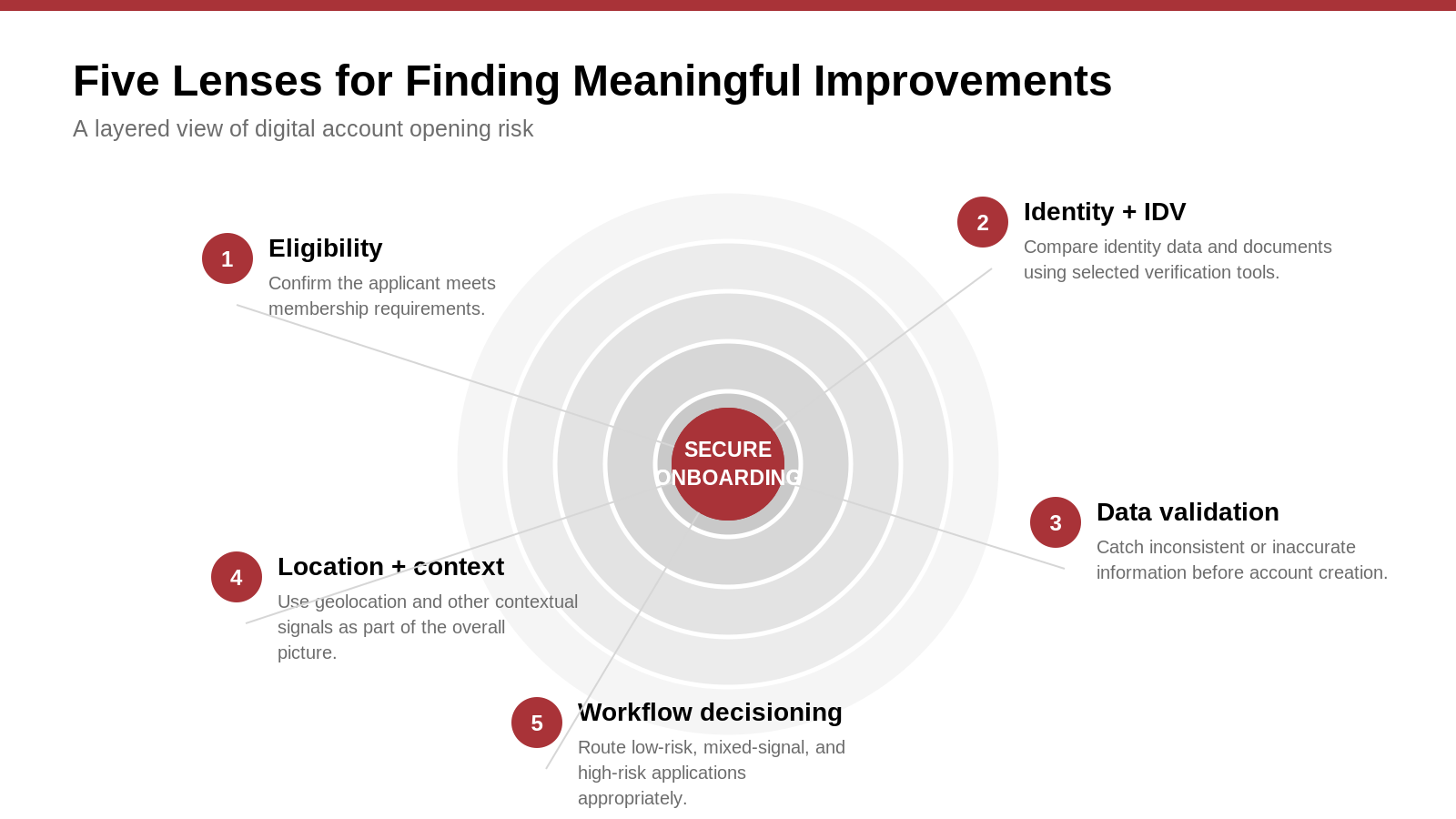
Lens 1: Start With Membership Eligibility
Credit unions have a consideration that many other financial institutions do not: membership eligibility. Before an account is opened, the credit union needs confidence that the prospective member qualifies to join.
That makes eligibility verification more than an administrative step. It can be an early fraud and workflow filter. If an application does not satisfy the credit union’s established eligibility rules, it should not travel through the same path as a qualified applicant.
Automating that check early can reduce unnecessary staff review and prevent an invalid application from moving deeper into the onboarding process. The exact logic will vary by credit union, which is why customization matters. A workflow designed around the institution’s actual rules can make eligibility part of the application decision instead of a task staff performs after submission.
The further an invalid application travels, the more opportunities it creates for manual work, inconsistent decisions, and unnecessary exposure. Eligibility is therefore a logical first lens in a layered strategy.
Lens 2: Verify That the Applicant Is Who They Claim to Be
Once eligibility is established, identity verification becomes one of the most important controls in the process. Digital account opening requires the credit union to establish confidence in an applicant it may never see in person.
Modern onboarding can combine applicant-provided information with identity verification services and document-based checks. Government-issued identification can also support data capture so the applicant does not have to type every field manually.
The ID should not be treated only as a document to collect. Information from it can become another source of data that is compared with what the applicant submitted. Names, addresses, dates, and other relevant fields can be checked for consistency before the account is created.
This is where identity verification, ID scanning, KYC processes, and Customer Due Diligence can become parts of a connected workflow rather than isolated administrative steps. Specific tools and configurations will vary by institution and vendor, but the operating principle is the same: verification results should influence what the workflow does next.
That does not eliminate staff judgment. It helps reserve staff judgment for applications that actually require it.
Lens 3: Use Data Validation to Catch Inconsistencies Early
Fraud prevention is often associated with sophisticated identity technology, but some of the most useful signals come from basic data consistency. A digital application contains names, addresses, ZIP codes, contact information, identification data, eligibility details, product selections, and other information that must ultimately become reliable core data.
If that information is accepted without validation, errors and suspicious inconsistencies can move downstream with the application. Some discrepancies are innocent. Applicants mistype information, use abbreviations, or enter an old address. Other inconsistencies deserve attention.
The value of data validation is not that every mismatch proves fraud. It is that the workflow can identify problems before they become account records. That distinction is especially important in an automated process: automating bad data only moves the problem faster.
For legitimate applicants, validation can improve the experience because mistakes can be corrected when they happen. For the credit union, it can improve data quality while giving suspicious patterns another opportunity to surface. Fraud prevention and data accuracy are closely connected.
Lens 4: Add Location and Other Contextual Risk Signals
Location does not tell the entire story about an applicant, but it can add useful context. A prospective member may legitimately apply while traveling or may live outside the immediate branch footprint and still qualify through an employer, association, family relationship, or another membership criterion.
That is why geolocation should be treated as a signal, not a simplistic pass-or-fail rule. When combined with eligibility information, identity verification, application data, and other available risk information, location can help the credit union evaluate whether the overall application behavior makes sense.
For example, an application may contain ordinary identity information while originating from a location that does not align with the rest of the information being presented. That mismatch may not justify an automatic decline, but it may justify additional verification or staff review.
This is an important principle in layered fraud prevention: individual signals do not have to make the entire decision. They can influence the path an application takes.
Lens 5: Turn Multiple Signals Into Workflow Decisions
This is where fraud prevention becomes a workflow problem rather than a collection of security tools. A credit union can purchase strong verification services and still create a weak process if the results from those services do not affect what happens next.
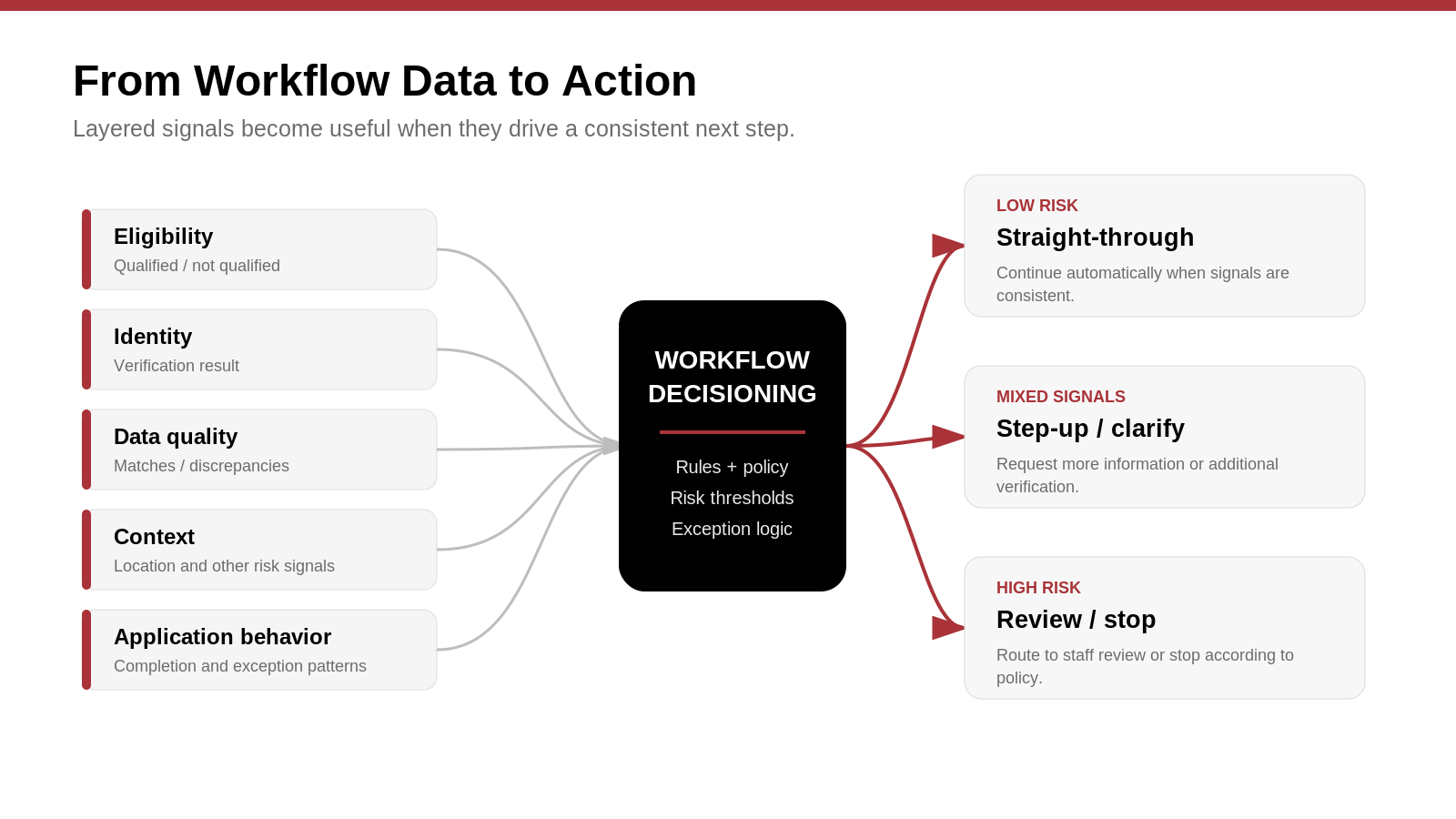
Consider two applications. The first applicant meets membership requirements, submits data that validates cleanly, provides identification that aligns with the application, and presents no meaningful contextual concerns. The second applicant technically clears one identity check, but several pieces of information do not align and another risk signal looks unusual.
Those applications should not necessarily travel through an identical workflow. The first may be a good candidate for straight-through processing. The second may need step-up verification, additional documentation, or staff review before an account is created.
A customizable workflow can turn combinations of signals into consistent actions: continue automatically, request more information, route for review, or stop the application according to the credit union’s policies and risk appetite. The important part is that the fraud controls are not merely present. They are connected to decisioning.
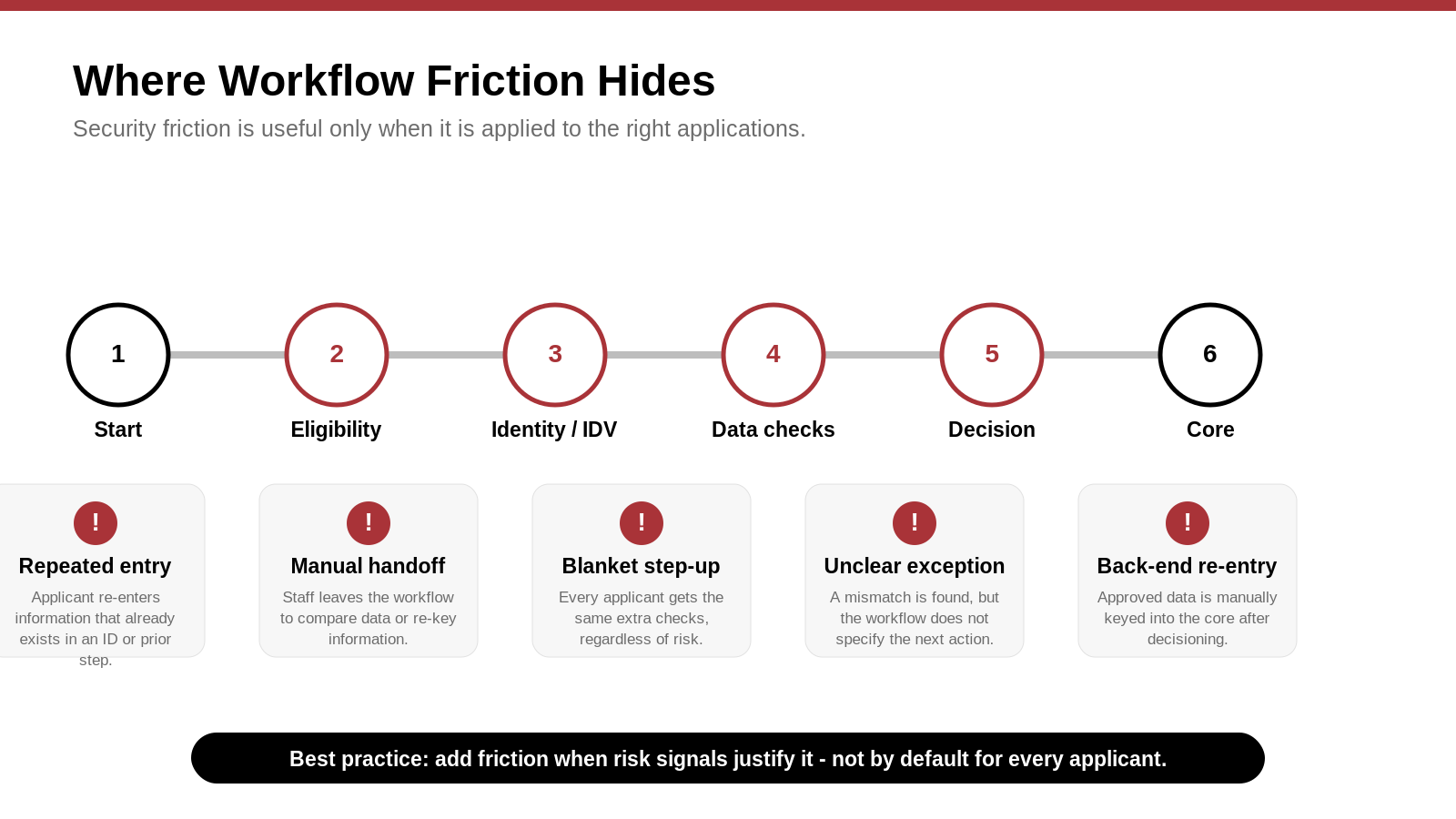
The Goal Is More Friction for Fraudsters, Not More Friction for Everyone
Security and member experience can appear to be pulling in opposite directions. One side wants stronger controls; the other wants fewer steps. Digital account opening requires both.
Adding the maximum amount of verification to every application may feel safer, but it can also create unnecessary friction for legitimate prospective members. Every additional field, document request, manual review, and delay creates another opportunity for abandonment. Removing meaningful controls in pursuit of speed creates the opposite problem.
The better goal is selective friction. Applicants whose information is consistent can move efficiently. Applications with unusual or conflicting signals receive additional scrutiny. Friction becomes a tool that is applied where risk warrants it rather than a default experience imposed on everyone.
This is one reason integrated automation can improve both security and usability. Pre-filling data from an identification document can reduce typing while creating structured information that can be validated. Automated eligibility checks can remove staff work while stopping unqualified applications earlier. Risk-based routing can allow ordinary applications to continue without waiting for an employee.
Why Direct Core Integration Matters
Fraud prevention does not end when the applicant clicks Submit. What happens after approval matters too.
A disconnected account opening platform may complete verification and then hand information off for staff to enter into the core. At that point, the credit union has introduced another risk: manual intervention between the approved application and the system of record. Re-keying names, addresses, identification details, and product selections creates opportunities for errors and delays, and it separates the fraud decision from account creation.
With a fully integrated workflow, validated application information can move into the core according to the credit union’s established rules. IMSI’s current Online Account Opening materials describe automated decisioning, third-party API integrations, eligibility verification, geolocation tracking, ID verification, secure document capabilities, and direct integration with Corelation KeyStone and Symitar Episys.
That connection matters because security is stronger when the decisioning process and the system of record are part of one controlled workflow. Staff should not have to manually compensate for systems that do not communicate. A digital account opening process should remain digital all the way through.
Automation Should Escalate Exceptions, Not Hide Them
Automation does not mean removing people from the process. In a strong account opening workflow, automation changes where people spend their time.
Staff should not have to manually review every ordinary application simply because the systems cannot make routine decisions. At the same time, suspicious or unusual applications should not disappear into an automated process simply because most applications are legitimate.
The workflow should separate the two. Routine, low-risk applications can follow the automated path defined by the credit union. Exceptions can be surfaced for attention: inconsistent data, failed verification, missing documentation, eligibility questions, or combinations of signals that warrant a closer look.
If employees spend less time reviewing applications that do not need intervention, they have more capacity to investigate the ones that do. That is a more scalable approach than treating every application as an exception.
Secure Follow-Up Is Part of the Fraud Strategy
Not every application can be resolved in the first pass. Sometimes staff needs another document. Sometimes the applicant needs to clarify information. Sometimes a review creates a question that has to be answered before the account can proceed.
The follow-up process is part of the security model. If the digital account opening workflow is secure but the applicant is then asked to move sensitive information through an uncontrolled channel, the credit union has introduced an avoidable gap.
A well-designed process keeps additional document collection and communication inside approved, secure channels. The member should not have to leave a protected onboarding experience simply because the credit union needs one more piece of information.
Fraud Prevention Should Be Customized to the Credit Union
There is no universal account opening workflow that fits every credit union. Membership rules differ. Risk policies differ. Products, third-party services, internal review procedures, and core environments differ.
That is why customization is particularly important in fraud prevention. A rigid solution forces the credit union to adapt its procedures to the software. A customizable workflow allows the software to reflect the institution’s procedures.
The difference becomes most visible when exceptions occur. What happens if identity verification succeeds but eligibility cannot be confirmed automatically? What if information validates but location is unusual? What if one piece of data fails validation? What conditions should trigger staff review? What should stop the application?
Those are workflow questions, and they should be answered intentionally rather than left to staff to resolve differently from one application to the next. Consistent rules can improve both security and member experience because the process becomes predictable. The right answer is not always more automation. It is the right automation for the credit union.
Third-Party Integrations Should Strengthen the Workflow, Not Fragment It
Credit unions rarely rely on a single technology provider for every part of digital account opening. Identity verification, document services, funding, signatures, communication, and other functions may involve different systems or vendors.
The challenge is making those technologies operate as one process. A third-party fraud tool provides limited operational value if staff has to leave the application, log into another platform, find the applicant, review the result, return to the original system, and manually decide what should happen next.
API integrations can help bring services into the account opening sequence so information moves between systems and results influence workflow rules. This is another reason the word ‘layered’ matters: fraud prevention should not become a stack of unrelated technologies. The layers need to communicate.
Each control should contribute information to the process, and the process should know what to do with that information. That is what turns a group of fraud tools into a fraud prevention strategy.
Review the Entire Path, Not Just the Approval Rate
Once a layered fraud prevention workflow is running, the work is not finished. Credit unions should continue evaluating how the process performs.
Are legitimate applicants being sent to manual review too often?
Are certain verification steps creating avoidable abandonment?
Where are staff spending the most time?
Are the same exception types appearing repeatedly?
Are validation failures usually suspicious, or are they often caused by confusing fields?
Are third-party integrations returning information quickly enough to support the desired experience?
Have policy, membership, product, or vendor changes been reflected in the workflow?
Fraud controls can become less effective when the surrounding process stops evolving. A workflow review is an opportunity to look at security, application behavior, operational friction, technology updates, and integration opportunities together.
A control that produces too many false positives can create staff overhead and applicant frustration. A shortcut that improves completion may introduce a risk gap. A third-party integration that made sense two years ago may have a better option today. The workflow should change as the credit union changes.
What a Layered Digital Account Opening Strategy Looks Like
A mature strategy does not depend on one dramatic checkpoint. It is built into the application from beginning to end.
The prospective member enters a digital workflow designed around the credit union’s requirements.
Membership eligibility is evaluated early.
Identity information is collected and verified using the institution’s selected services.
Identification documents can support data capture and comparison.
Application information is validated for accuracy and consistency.
Location and other contextual risk signals provide additional information where appropriate.
Rules determine which applications can continue automatically and which need step-up verification or staff review.
Secure follow-up supports exceptions without moving sensitive information outside approved channels.
Approved, validated information moves into the core without unnecessary re-entry.
No single control has to do everything. Each layer has a specific job, and the workflow brings the results together.
Build Security Into the Experience From the Beginning
Digital account opening creates an important first impression. A prospective member is deciding whether the credit union is easy to work with, whether its technology feels current, and whether they trust the institution with a new financial relationship.
A slow or confusing process can undermine that trust. So can a process that appears careless with sensitive information. The answer is not to choose between security and convenience. It is to design them together.
Layered fraud prevention gives credit unions a practical framework for doing that. Eligibility checks, identity verification, data validation, document handling, contextual risk signals, KYC and CDD processes where applicable, rules-based workflows, third-party integrations, secure exception handling, and direct core connectivity each address a different part of the problem.
The real value appears when those capabilities operate as one connected process. IMSI’s approach to Online Account Opening is built around that same idea: a customizable member-facing workflow that connects directly with the credit union’s technology environment and supports automation while allowing the institution to incorporate the verification and fraud-prevention tools that fit its policies.
For Corelation KeyStone and Symitar Episys credit unions, digital account opening does not have to be a separate front-end experience that creates more back-office work. It can be an integrated workflow designed around the way the credit union actually operates.
Fraud strategies will continue to evolve, and member expectations will too. The sustainable approach is not to search for one tool that solves every problem. It is to create a workflow where multiple layers of verification, validation, decisioning, integration, and human review work together – and where those layers can continue to change as the credit union’s needs change.
If your credit union is evaluating its digital account opening process, IMS Integration can help you build a customized workflow that supports a seamless member experience while incorporating the fraud prevention and verification tools that fit your institution.
Schedule a demo to see how IMSI’s Online Account Opening solution can integrate with your core and support a more secure, efficient onboarding experience.