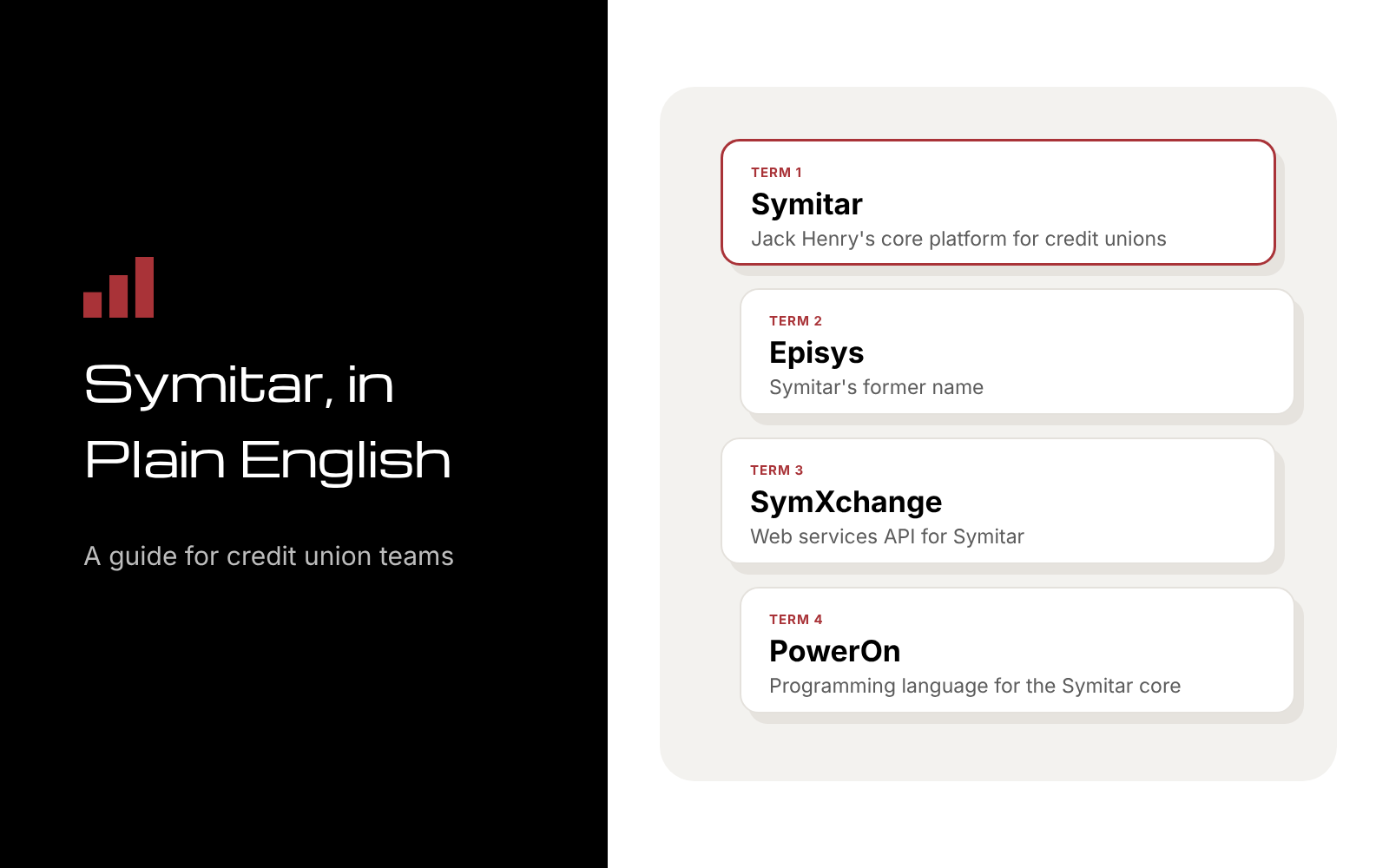
Symitar is Jack Henry’s core platform built specifically for credit unions, and it was formerly known as Episys. More than 700 credit unions have implemented it, ranging from $21 million to more than $36 billion in assets. Credit unions run it on premises or in a private cloud, and third-party solutions connect to it through Jack Henry’s SymXchange interface.
This guide covers the naming, how Symitar is deployed, how other solutions connect to it, and a short glossary for new staff and board members.
What Is Symitar?
Symitar is the core system Jack Henry offers to credit unions. In its fiscal 2026 annual report, Jack Henry describes Symitar as a system designed specifically for credit unions and says more than 700 credit unions have implemented it (Jack Henry 2026 Annual Report). Jack Henry itself was founded in 1976.
A core is where members, accounts, loans and transactions live. Online banking, account opening, lending, payments and statements all read from it or write to it. That’s why the core shapes almost every technology decision a credit union makes, and why it helps to know the vocabulary that comes with it.
Where Does Symitar Fit With Your Other Systems?
The core holds the official record: who your members are, what accounts and loans they have, and every transaction. Around it sit the systems members and staff touch every day, such as online and mobile banking, account opening, loan origination, card processing, statements and back-office tools.
Each of those systems reads from Symitar, writes to it, or both. The fewer hand-offs between them and the core, the less staff time goes to re-keying and reconciling. That’s why the way a solution connects to Symitar matters as much as what it does on screen.
Is Episys the Same as Symitar?
Yes. Jack Henry’s current materials call the platform Symitar and note that it was formerly known as Episys (Jack Henry 2026 Annual Report). Older Jack Henry announcements use both names. A 2018 release, for example, describes a credit union converting to the Episys core platform and calls Symitar a division of Jack Henry (Jack Henry, August 23, 2018).
You’ll still hear Episys in conversation and see it in older contracts and documentation. When you search for vendors or technical documents, try both names.
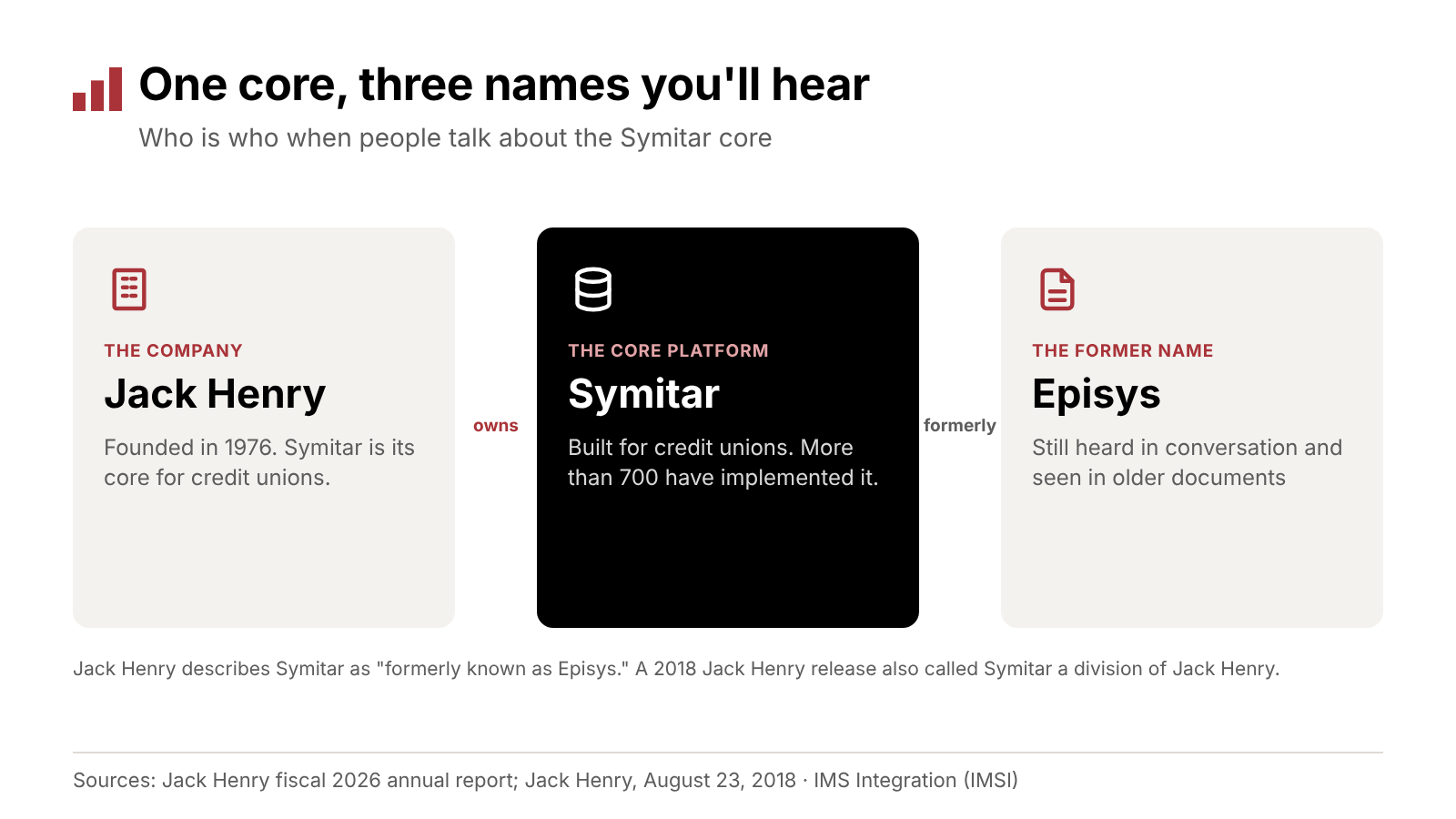
Jack Henry is the company, Symitar is its core platform for credit unions, and Episys is the platform’s former name.
How Do Credit Unions Run Symitar?
Jack Henry says its credit union core can be delivered three ways: on premises, through Jack Henry’s private cloud, or through its partner private cloud delivery models (Jack Henry 2026 Annual Report).
- On premises. The credit union runs the core in its own environment and manages it with its own team.
- Jack Henry’s private cloud. Jack Henry hosts the core for the credit union.
- Partner private cloud. A Jack Henry partner hosts the core.
The choice tends to last. Jack Henry’s annual report notes that clients who outsource core processing typically sign six-year contracts.
The deployment model also affects how upgrades are scheduled, who manages the environment, and how third-party connections are set up. Ask about it early in any integration project.
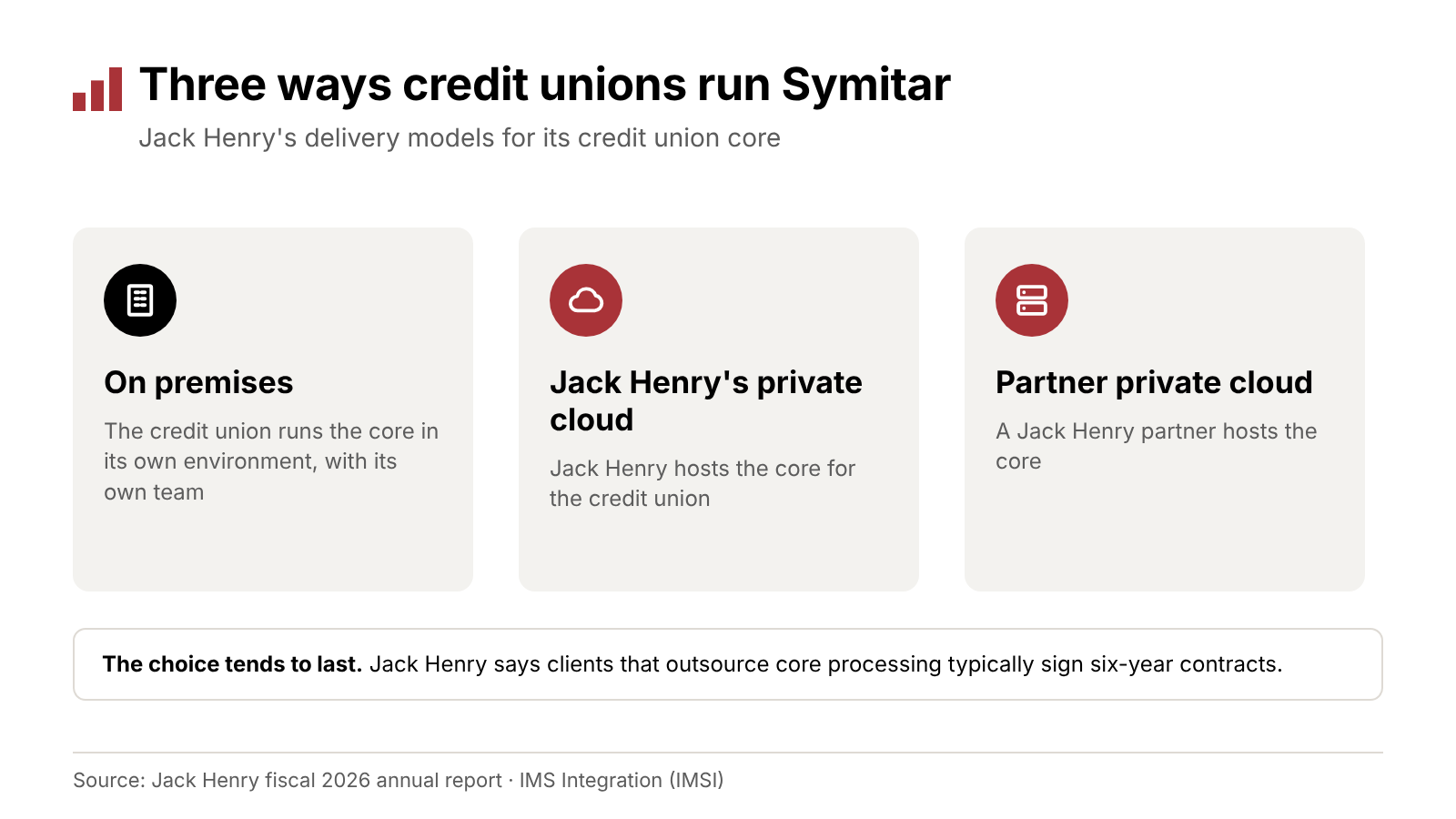
Jack Henry delivers its credit union core on premises, through its private cloud, or through partner private clouds.
How Do Third-Party Solutions Connect to Symitar?
Most credit unions run many solutions around the core: digital banking, account opening, lending, payments and statements. On Symitar, two Jack Henry tools come up again and again.
SymXchange is Jack Henry’s web services API for Symitar. It lets third-party vendors, credit unions and Jack Henry products run transactions, inquiries and file maintenance on member accounts, and it can run PowerOn specfiles. It’s built on XML, WSDL and SOAP (Jack Henry SymXchange documentation).
PowerOn is a programming language that enables functionality on the Symitar core. PowerOn files are installed on the core and called through SymXchange (Jack Henry, PowerOns).
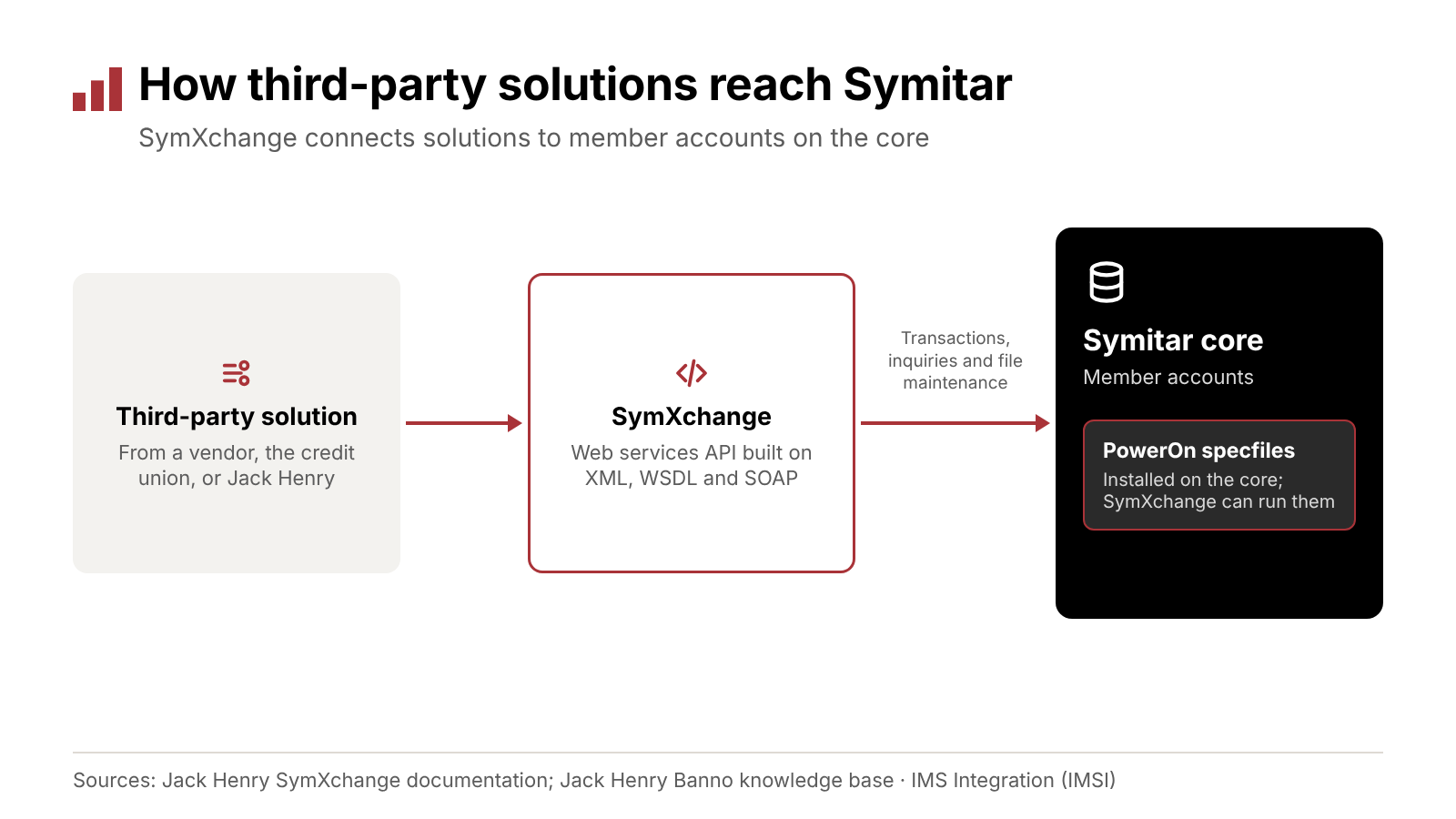
Third-party solutions reach member accounts through SymXchange, which can also run PowerOn specfiles installed on the core.
For a credit union, the practical questions follow from those two tools: who installs and maintains any specfiles a vendor needs, how the vendor connects, and who tests the connection when Symitar is upgraded. Our Jack Henry Connect post lists 12 questions to ask any vendor before you sign.
How Can New Staff and Board Members Get Up to Speed?
You don’t need to be a programmer to understand your core. A few steps cover most of what a new leader or board member needs:
- Learn the vocabulary. Start with the glossary below.
- Know your deployment model. Ask your core team whether you run Symitar on premises or in a private cloud, and who manages it.
- Map your connections. List the solutions that read from or write to Symitar, and how each one connects.
- Go to the source for detail. Technical staff can start with Jack Henry’s SymXchange documentation.
A Short Symitar Glossary
| Term | What it means |
|---|---|
| Jack Henry | The company behind Symitar, founded in 1976. |
| Symitar | Jack Henry’s core platform designed specifically for credit unions. |
| Episys | Symitar’s former name, still common in conversation and older documents. |
| SymXchange | Jack Henry’s web services API for Symitar, used for transactions, inquiries and file maintenance on member accounts. |
| PowerOn | A programming language that enables functionality on the Symitar core. |
| Specfile | A PowerOn file installed on the core. SymXchange can run it. |
| On premises | Symitar running in the credit union’s own environment. |
| Private cloud | Symitar delivered from Jack Henry’s private cloud or a partner’s. |
| Core conversion | The move from one core platform to another. |
How IMSI Helps Symitar Credit Unions
IMS Integration (IMSI) builds solutions for credit unions on Symitar, tailored to how each credit union works. Our Symitar page lists nine:
| Solution | What it does |
|---|---|
| Online Account Opening | A digital account opening process for new member enrollment. |
| Make-a-Statement | Clear digital statements members can access online. |
| Loan Payment | A user-friendly digital platform for secure, efficient loan payments. |
| Skip-a-Pay | A self-service tool that lets members defer loan payments. |
| Trial Balance | Enhanced reporting for accurate trial balances. |
| Courtesy Pay | Automates overdraft protection. |
| Workbox Messaging Center | A centralized platform where staff and members securely send and receive messages and documents. |
| AppFlow Loan | A streamlined, credit union managed loan application workflow. |
| AppFlow Account | A streamlined, credit union managed membership application workflow. |
Other IMSI solutions are built for Corelation KeyStone, so if you run Symitar, start from the Symitar list.
Our aim on Symitar is the same as on KeyStone: help you get more from your core, so members can do more on their own and your team spends less time on manual work.
IMSI has been founder-led since 2007 and serves hundreds of credit unions.
Frequently Asked Questions
Who owns Symitar? Jack Henry. Symitar is its core platform for credit unions.
Is Episys the same as Symitar? Yes. Episys is the platform’s former name, and Jack Henry now calls it Symitar.
How many credit unions use Symitar? More than 700 credit unions have implemented it, according to Jack Henry’s fiscal 2026 annual report.
Can Symitar run in the cloud? Yes. Jack Henry delivers it through its own private cloud or through partner private clouds, as well as on premises.
Is Symitar only for credit unions? Jack Henry describes it as a system designed specifically for credit unions.
What’s the difference between SymXchange and PowerOn? SymXchange is the web services API that vendors and credit unions use to work with member accounts. PowerOn is a programming language for adding functionality on the core, and SymXchange can run PowerOn specfiles.
See which IMSI solutions fit your Symitar core. Schedule a strategy call
Related reading
- Heading to Jack Henry Connect? Symitar Integration Questions to Ask
- Vendor Due Diligence: Security Questions to Ask Before Core Access
- Preparing for a Core Conversion: Reducing Migration Risk
Devon Wilson is a founding partner of IMS Integration (IMSI). He has spent more than 30 years in credit union technology helping credit unions improve their systems and service delivery, and he speaks at industry events nationwide.