
A workflow can be working exactly as it was designed and still be ready for improvement.
Credit union operations change throughout the year. Member expectations shift. Staff develop new habits around the tools they use every day. New products, policies, vendors, and compliance requirements are introduced. A workflow that made sense at implementation can gradually accumulate extra steps, new exceptions, and manual workarounds that were never part of the original plan.
That is why IMS Integration includes a complimentary annual workflow review as part of the customer relationship. The review is an opportunity to look at how your workflows are performing now, not simply how they were configured when they launched. It brings together real usage data, operational feedback, member behavior, design considerations, technology changes, and integration opportunities so your credit union can decide where refinement will make the biggest difference.
The purpose is not to change a process just because another year has passed. It is to make sure the workflow still reflects the way your credit union wants to operate and the experience you want members to have.
The Review Starts With How the Workflow Is Actually Being Used
A workflow diagram can show what is supposed to happen. The annual review focuses on what is actually happening.
That distinction matters. Members do not always move through a digital experience in the way the implementation team expected. Staff may discover that a certain exception requires extra follow-up. A field that seemed necessary at launch may now create confusion. A new third-party tool may have introduced another handoff. A process that once required staff intervention may now be a good candidate for automation.
Looking at workflow data helps separate assumptions from patterns. For an account opening workflow, for example, the review may look at where applicants are completing the process successfully and where they are getting stuck or abandoning the application. If a large number of applicants consistently stop at the same point, the right question is not simply whether the page is functioning. The better question is what about that part of the experience is creating friction.
The answer could be related to wording, document requirements, identity verification, funding, the number of steps, or something happening behind the scenes. The data gives the review a place to start. From there, the conversation can move into the operational reasons behind the numbers.
This approach keeps the annual review practical. Instead of discussing workflow optimization in general terms, your team can focus on specific parts of the process that may be affecting completion, staff workload, data quality, or member satisfaction.
Member Experience Is One Part of the Picture
A member-facing workflow should be easy to use, but ease of use is only one measure of a successful process.
The annual review also looks at what happens after the member clicks Submit.
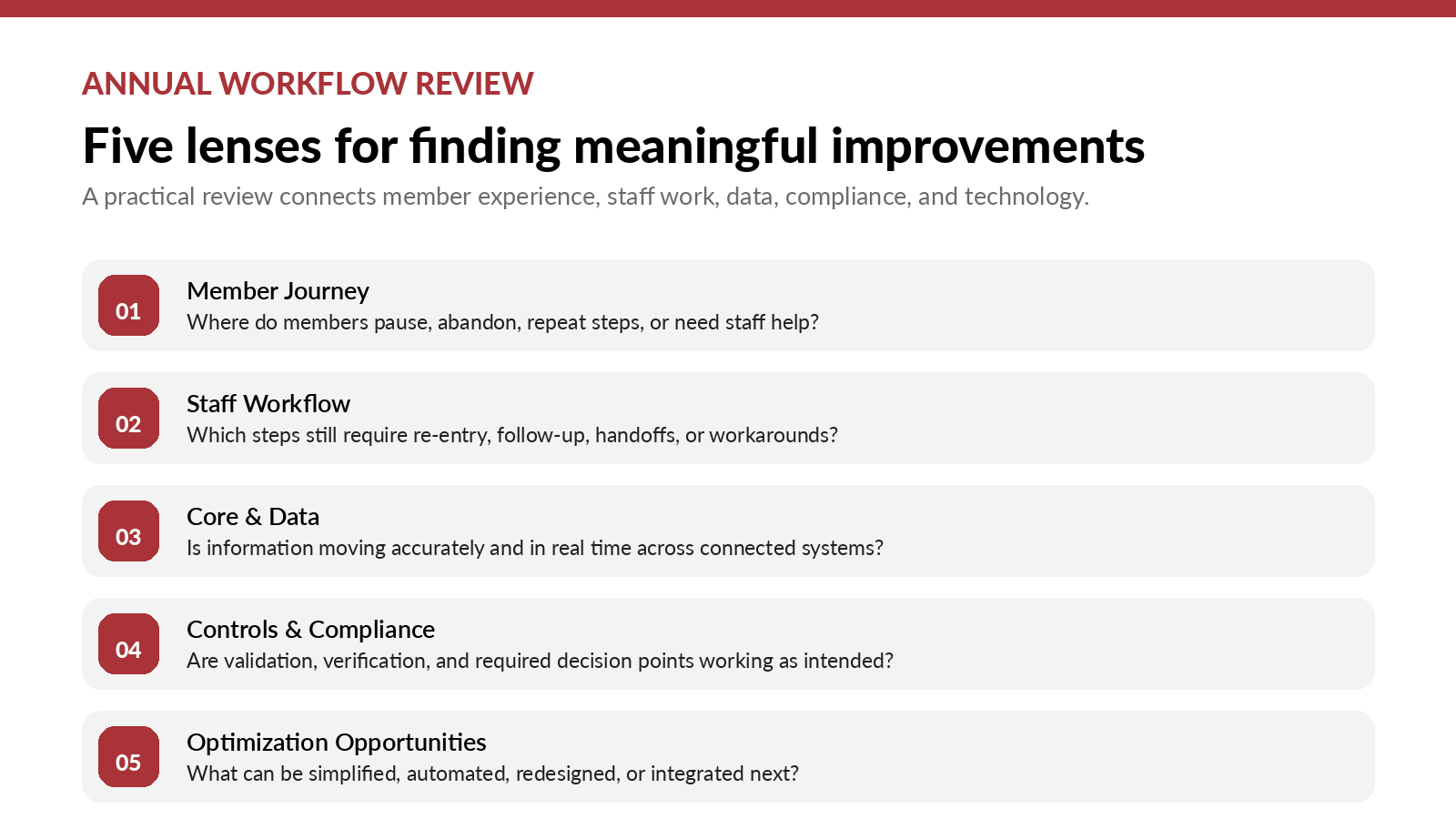
Consider a digital account opening experience. From the member’s perspective, the process may appear fully online. Behind the scenes, however, staff could still be reviewing information manually, re-entering data, sending emails for missing documents, moving information between systems, or correcting records after the account is created. The front end may look modern while the back office is doing the work required to hold the process together.
That kind of manual bridging is exactly where a workflow review can be valuable. It creates an opportunity to ask whether the systems involved are doing the work they should be doing automatically.
For credit unions on Corelation KeyStone or Symitar Episys, that question often comes back to core integration. A tightly integrated workflow can read from and write to the core directly, allowing member actions to trigger the appropriate next steps without requiring staff to move the same information from one platform to another. When the workflow and the core stay connected, the member experience and the staff experience improve together.
The annual review therefore looks at both sides of the process. Where are members encountering unnecessary effort? Where are employees filling gaps that technology should be handling? Where do exceptions occur? Which tasks require judgment, and which ones are simply repetitive?
A good workflow does not eliminate people from the process. It eliminates the unnecessary work that prevents people from focusing on higher-value member needs.
Expect a Conversation About Friction, Not Just Features
It is easy for a technology review to become a tour of features. That is not the most useful way to evaluate a workflow.
Features only matter when they solve a real problem. The annual workflow review is more useful when it begins with friction: the places where members slow down, staff spend extra time, data needs to be corrected, or a process depends on a workaround.
Some friction is obvious. Staff may be able to point to a step they repeat dozens of times each week. Other friction is quieter. A small amount of manual re-entry may not feel significant on one application, but it becomes a major operational cost when the same task is repeated across hundreds or thousands of transactions. A delay of a few minutes may seem minor until it becomes part of every member request. An extra email may not appear on a process map at all, even though it is essential to completing the workflow.
The review creates space to identify those hidden dependencies.
That can include member-facing pain points such as unclear instructions, repeated questions, unnecessary branch or phone requirements, or application stages with high abandonment. It can also include internal issues such as duplicate data entry, manual document handling, staff switching between multiple systems, exception queues, spreadsheet tracking, or processes that depend heavily on one employee knowing how to make everything work.
The goal is not to label every manual step as a failure. Some steps should remain manual because they require judgment, escalation, or a personal conversation. The goal is to distinguish intentional human involvement from manual work that exists only because systems are not connected, or the workflow has not been updated.
Your Core Integration Should Be Part of the Review
For IMSI customers, workflow optimization is closely connected to the core because IMSI solutions are designed to operate as extensions of the credit union’s core environment.
That architecture changes the review conversation. Instead of asking only whether a digital form is attractive or whether staff like a screen, the review can examine how the entire process moves data and triggers action.
Does the workflow pull the information it needs from the core? Are updates written back in real time? Are staff members correcting information that should already be synchronized? Are members being asked for information the credit union already has? Does a completed request create the right records and next steps automatically? Are there places where a third-party system has introduced another layer of manual processing?
These questions are important because operational efficiency is rarely determined by one screen. It is determined by the handoffs between systems.
A member may complete a request in two minutes, but if the request then waits in a queue for a staff member to re-enter the data, the process is not truly automated. A workflow may collect accurate information, but if another system receives that data through a delayed or incomplete transfer, staff still have to reconcile the difference. A self-service option may reduce branch traffic, but if every request generates a manual back-office task, the workload has simply moved.
The annual review helps surface those gaps and determine whether an integration, configuration change, workflow adjustment, or different use of an existing capability could remove them.
Data Quality and Compliance Deserve Their Own Attention
Speed is important, but a faster workflow is not better if it produces incomplete or inconsistent information.
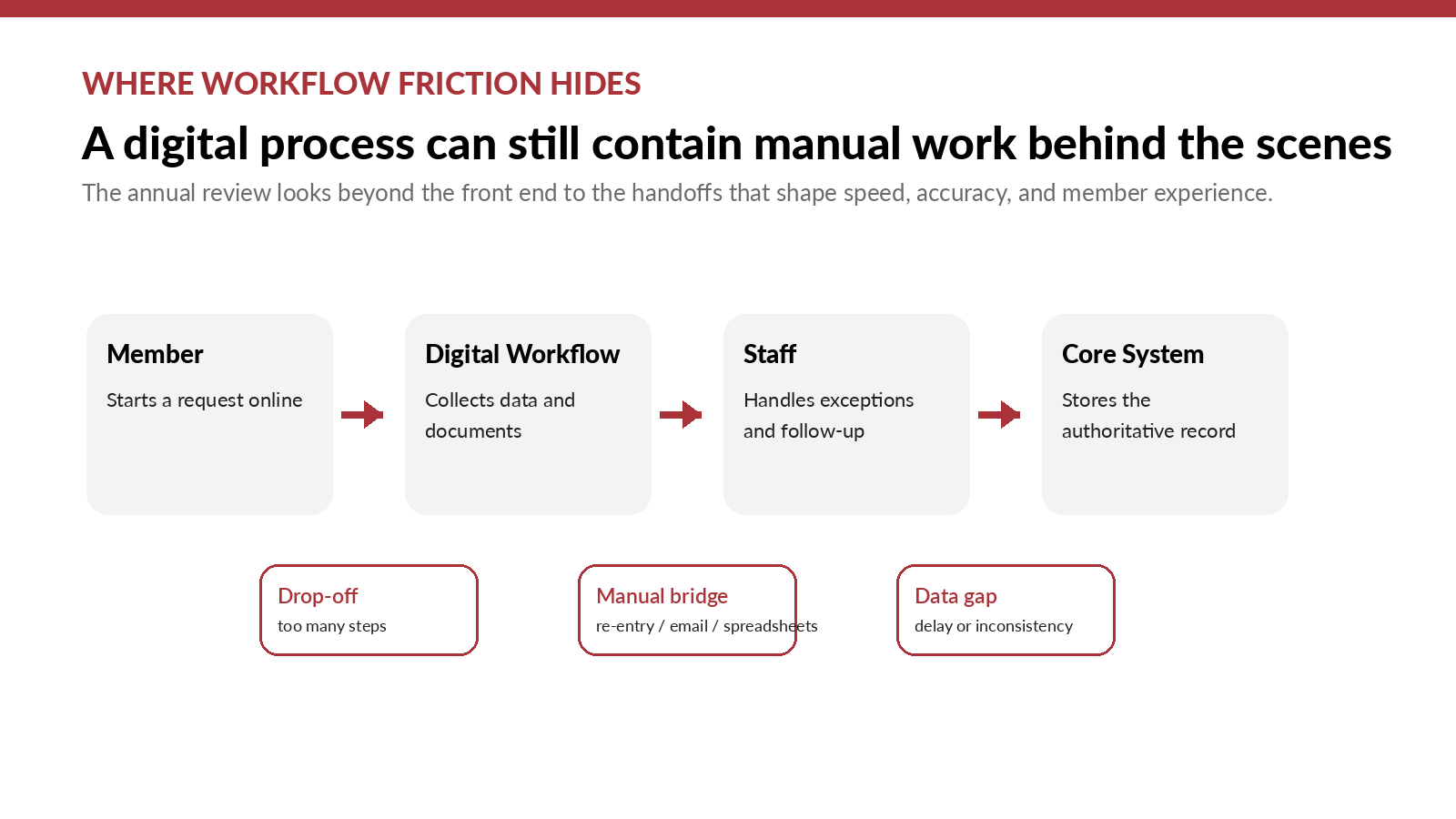
Credit union workflows have to balance convenience with controls. Identity verification, Know Your Customer requirements, Customer Due Diligence, data validation, document collection, disclosures, and other required steps need to be incorporated in ways that support compliance without creating unnecessary friction for members or staff.
An annual review is a useful time to revisit those controls because both technology and operational requirements evolve.
A validation rule that was appropriate when a workflow launched may need to be adjusted. A new verification option may be available. A third-party integration may have changed. Staff may be handling an exception manually because the original configuration does not account for a scenario that has become common. A required step may be happening at the wrong point in the process, creating repeat work when an application does not proceed.
The review can help your team consider whether the workflow is gathering the right information at the right time and whether automated validation is being used effectively. The objective is to support accurate, compliant processing while keeping the member experience as straightforward as possible.
This is also where tightly integrated systems can help. When accurate information flows directly into the core and connected tools use the same authoritative data, the credit union reduces the opportunities for discrepancies created by re-entry, delayed synchronization, or multiple versions of the same member record.
That consistency supports more than efficiency. It makes the entire workflow easier to manage because staff are spending less time figuring out which system has the correct information.
You May Find Opportunities to Simplify Before You Add Anything New
Workflow improvement does not always require another product.
Sometimes the biggest gain comes from removing a step, changing the order of a process, updating a decision rule, clarifying content, automating a notification, or taking better advantage of a capability that is already available.
That is one reason an annual review is valuable. Over time, teams naturally add layers to processes. A special case becomes a permanent step. A temporary workaround turns into standard procedure. A field is added because one department needs it, even though it creates friction for every applicant. Staff creates a spreadsheet because a report was not available at the time, and the spreadsheet remains long after a better option exists.
The review gives your credit union a reason to question those layers.
Does this step still serve a purpose? Can the workflow make this decision automatically? Is the same information being collected twice? Could a secure message replace an email chain? Could a member complete this request through self-service instead of calling the credit union? Is a staff task necessary, or is it simply the result of two systems not communicating?
Simplification is often one of the most effective forms of optimization because it reduces effort at multiple points. Members have fewer steps to complete. Staff has fewer exceptions to manage. Training becomes easier. Data moves through a cleaner path. Future changes become less complicated because there are fewer dependencies to maintain.
The right annual review should be open to both possibilities: adding a capability when there is a clear need and removing complexity when the workflow has accumulated more than it needs.
Design and Member Expectations Change, Too
A workflow is an operational tool, but it is also part of the member experience.
Members compare digital interactions across every part of their lives. They are used to mobile-first experiences, clear progress indicators, immediate confirmation, simple language, and the ability to complete tasks without switching channels. A credit union workflow that felt modern several years ago can start to feel cumbersome even if the underlying process has not changed.
That is why IMSI’s annual workflow review also creates an opportunity to discuss design trends and user experience updates.
This does not mean redesigning a workflow every year. It means looking at the experience with fresh eyes. Are instructions still clear? Does the workflow work well on the devices members are actually using? Are the most important actions easy to find? Are there points where the member is unsure what happens next? Can information be presented more clearly? Does the workflow still match the credit union’s current branding and digital standards?
Small design improvements can have a meaningful operational effect. Better instructions can reduce incomplete submissions. Clearer error messages can reduce calls. A more intuitive sequence can improve completion. Better mobile usability can help members finish a process they might otherwise abandon.
Design and operations are not separate conversations. In a digital workflow, they affect each other directly.
Technology Updates and New Integrations Can Change What Is Possible
The workflow you have today was built within the technology environment that existed when it was implemented. That environment does not stand still.
Core capabilities evolve. Third-party vendors release new APIs. Digital banking platforms add features. New verification and payment options become available. IMSI continues to develop new integrations and enhancements across its credit union solutions.
The annual workflow review is a natural place to discuss those changes in the context of your credit union rather than as a generic product update.
The important question is not, “What is new?” It is, “Does anything new solve a problem we are currently experiencing?”
A new integration may eliminate a manual handoff. An updated feature may allow members to self-service a request that previously required staff assistance. A different approach to messaging may keep application follow-up inside a secure workflow. A change in how data is validated may reduce correction work. A new connection to the core may allow information to move in real time where it previously relied on a separate process.
Connecting technology updates to operational goals keeps the review focused. Your credit union does not need to implement every new capability. It needs to understand which capabilities can improve the workflows that matter most.
The Best Reviews Include the People Who Know the Process
Workflow data tells you what is happening. Staff can often tell you why.
The employees who use a process every day know where the extra clicks are. They know which exceptions create the most follow-up. They know which member questions come up repeatedly. They know which steps require a workaround that is invisible to leadership because the workaround has become routine.
Bringing that operational perspective into the annual review makes the discussion more accurate.
Depending on the workflow, that could include leaders from operations, lending, member service, compliance, IT, digital banking, or other teams that touch the process. The review does not need to become a large committee meeting, but it benefits from input from the people who understand both the member-facing and back-office realities.
A useful preparation step is to gather a short set of examples before the conversation. Think about recent member complaints, frequent staff questions, recurring exceptions, processes that require spreadsheet tracking, steps that generate repeated follow-up, and areas where employees say, “We have always had to do it that way.” Those examples help turn the review into a practical discussion quickly.
It is also helpful to come with goals. If the credit union wants to increase digital adoption, improve application completion, reduce staff processing time, expand self-service, improve data consistency, or prepare for growth, those priorities should shape the recommendations.
The annual review works best when optimization is tied to an operational outcome rather than a vague desire to make the workflow “better.”
What Recommendations Should Look Like
A strong workflow review should leave your team with clarity about what matters most.
Not every observation needs to become a project. Some items may be simple configuration changes. Others may require additional investigation, development, or coordination with a third-party vendor. Some may be worth monitoring rather than changing immediately.
The useful output is a prioritized view of opportunities.
For example, a high-impact recommendation might address a point in an account opening workflow where a meaningful number of prospective members are abandoning the application. Another recommendation might eliminate a repetitive back-office step that consumes staff time every day. A lower-priority item might be a design refinement that improves consistency but does not materially affect completion or processing.
Prioritization keeps the credit union from treating optimization as an all-or-nothing project. Workflows can improve incrementally. One targeted change can reduce friction now, while a larger integration opportunity becomes part of a future roadmap.
That incremental approach aligns well with how credit unions actually operate. Technology environments are interconnected, budgets and resources are finite, and operational change has to be managed carefully. A good annual review helps identify the improvements that are worth making first.
The Review Is Also a Chance to Reconnect Technology With Strategy
Day-to-day operations can make technology feel tactical. A workflow becomes something staff uses to get through a task. The annual review creates an opportunity to reconnect that workflow with broader credit union goals.
Is the credit union trying to grow membership without increasing staffing at the same rate? Then application completion, automated decisioning, and self-service may be central to the conversation. Is the priority to improve member retention? Then ease of service, digital convenience, secure communication, and consistency across channels may matter more. Is the organization trying to reduce operating costs? Then manual processing, duplicate systems, document handling, and repetitive staff tasks deserve attention.
The same workflow can support several strategic goals when it is designed and integrated well.
That is why IMSI’s approach is centered on customized, fully integrated core solutions rather than one-size-fits-all workflows. Two credit unions can use the same core and still have different operating models, products, policies, staffing structures, member demographics, and growth plans. The workflow should reflect those differences.
The annual review is one of the ways to keep that customization current.
What Happens After the Review Matters Most
A review has limited value if the findings stay in a meeting recap.
The next step is to decide what should change, what should be monitored, and what belongs on a longer-term roadmap. Some updates may be straightforward. Others may require additional discovery or coordination. The important part is that the review turns into action that can be evaluated later.
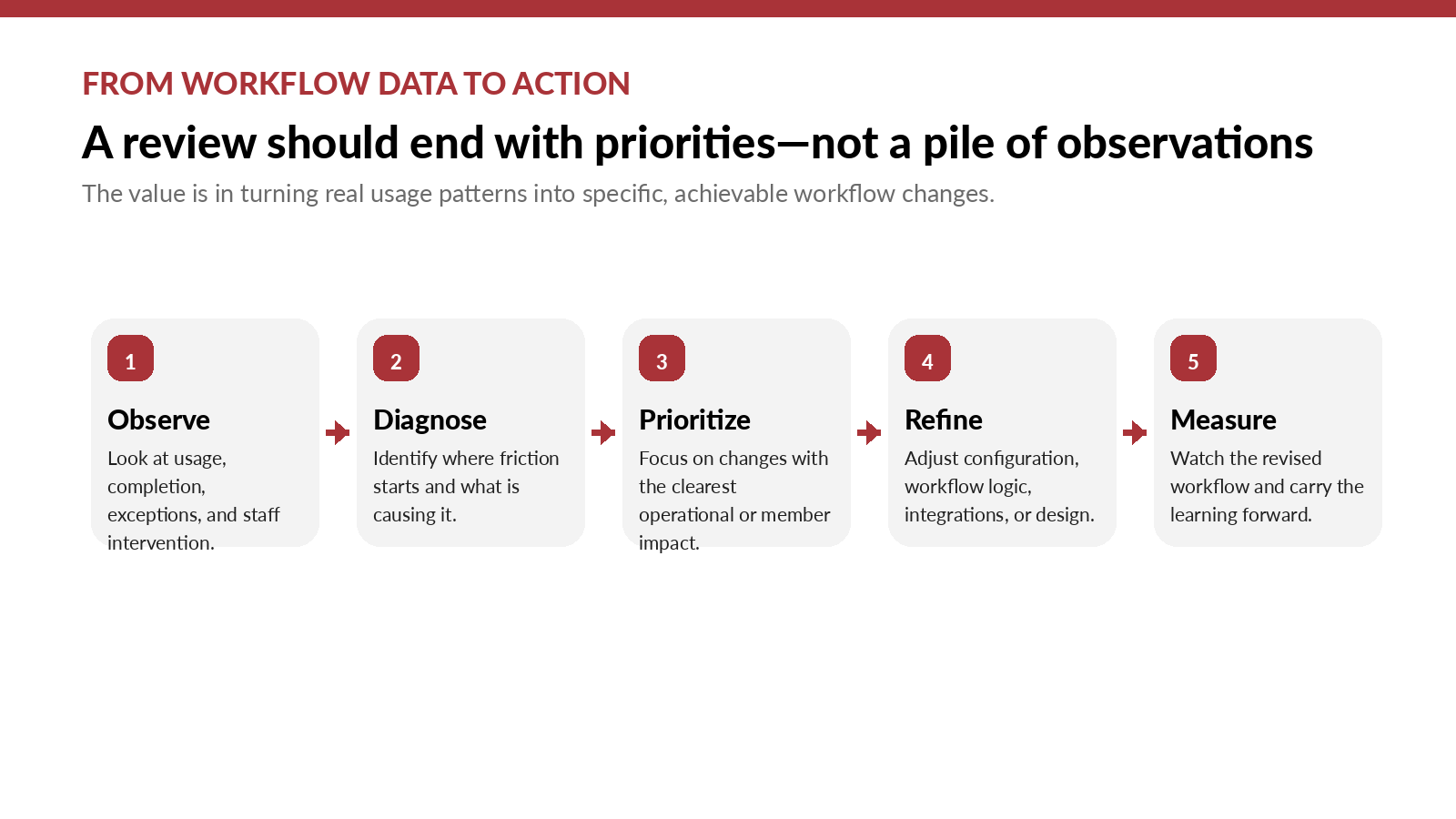
That creates a useful cycle. Observe how the workflow is performing. Identify the source of friction. Prioritize the improvements that matter. Refine the process. Then measure what happens next.
Over time, that cycle keeps the workflow aligned with the credit union instead of allowing the credit union to adapt around the limitations of an aging process.
It also makes future reviews more valuable because each year begins with better context. Your team can look at what changed, what improved, what new issues emerged, and how member or staff behavior shifted after the previous adjustments.
Optimization becomes an ongoing discipline rather than a one-time implementation project.
Make the Most of Your Annual Workflow Review
Your credit union should not have to live with unnecessary friction simply because a workflow is already in production.
The annual workflow review is a chance to look at the process with fresh eyes and real data. It can reveal where members are getting stuck, where staff are performing work the system could automate, where data is not moving as cleanly as it should, and where new capabilities could improve the experience.
Just as important, it gives your team time to talk through what has changed in your operation and what you want the workflow to accomplish next.
IMSI builds and customizes fully integrated core solutions for credit unions on platforms including Corelation KeyStone and Symitar Episys. Our focus is not simply to deliver a workflow and move on. We work with credit unions to keep those workflows useful, efficient, and aligned with the member experience over time.
If your annual workflow review is coming up, bring the pain points your team has noticed, the goals you are working toward, and the questions you have about what is possible. We will bring the data, the integration perspective, and the experience to help identify where the next improvement can make the biggest difference.
Ready to review your current workflows? Contact IMS Integration to start the conversation.