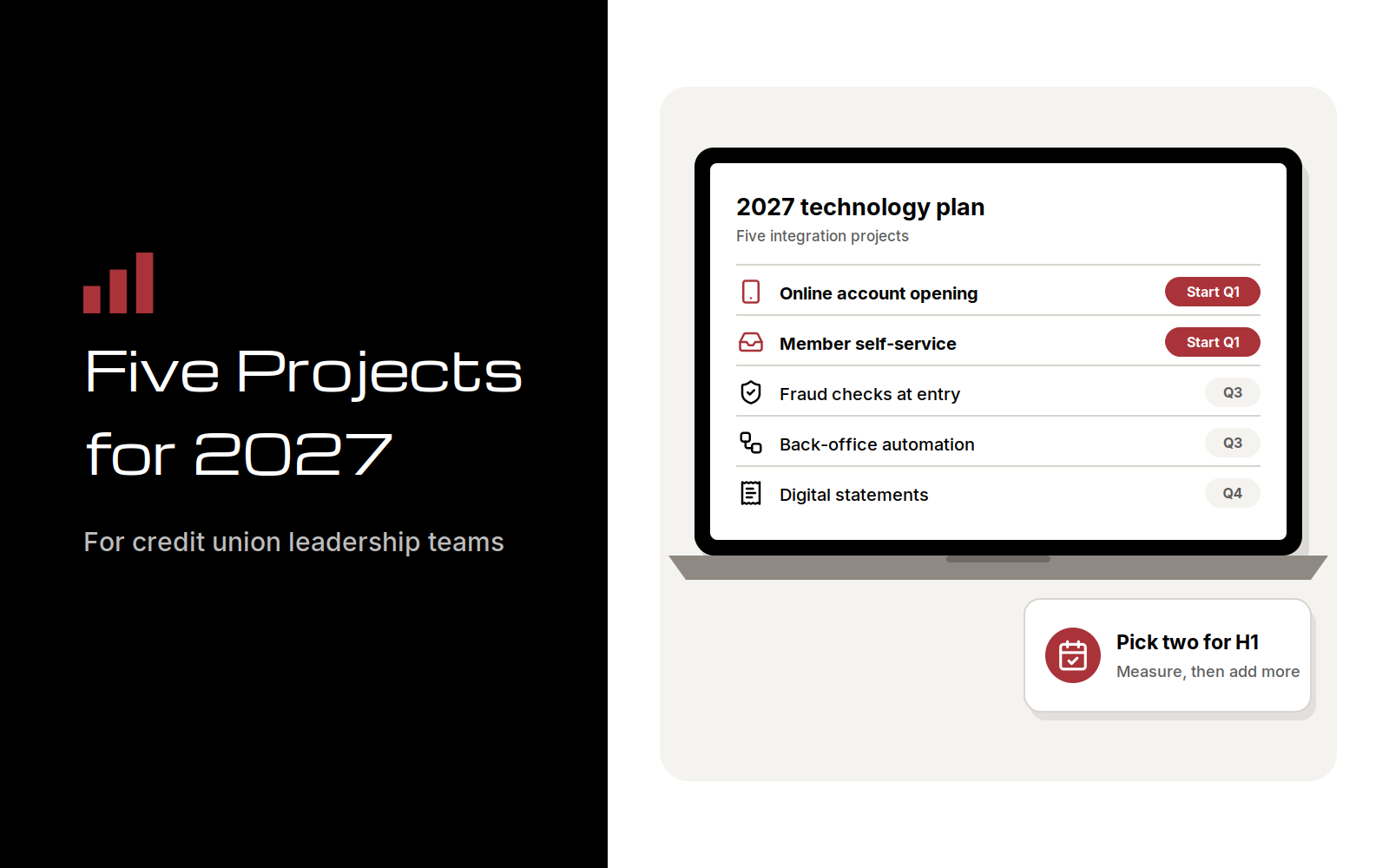
If you’re setting a 2027 technology budget, five integration projects deserve a line: online account opening that members finish, self-service for everyday requests, fraud checks at the point of application, back-office automation that ends re-keying, and digital statements. Each one connects to the core you already run, so the payoff shows up in member growth and staff time, not just in a new screen. Here’s how to weigh them and what to put in the request.
How to Evaluate an Integration Project
Technology budgets are growing. In Cornerstone Advisors’ What’s Going On in Banking 2026 study, more than 80% of banks and credit unions planned to increase technology spending in 2026 (Cornerstone Advisors, January 29, 2026). The harder question is where each dollar goes.
Growth makes the stakes plain. Federally insured credit unions added 2.3 million members in the year to June 30, 2026, reaching 146.1 million (NCUA Quarterly Data Summary, Q2 2026). Yet at the median, membership fell 0.6%, according to the National Credit Union Administration (NCUA) (NCUA, September 23, 2026). The typical credit union is shrinking while the system grows.
Before any project earns a line, run it through four tests:
- Does it post to the core? A tool that creates another place for data to live adds work. One that reads from and writes to the core removes it.
- Can you count the staff time it returns? If you can’t say how many requests or applications staff handle today, measure that first.
- Will members notice? Strong candidates change something members do every week or every year.
- Can you measure the baseline now? Completion rates, call volumes, and hours spent should be known before you sign, so you can prove the result after.
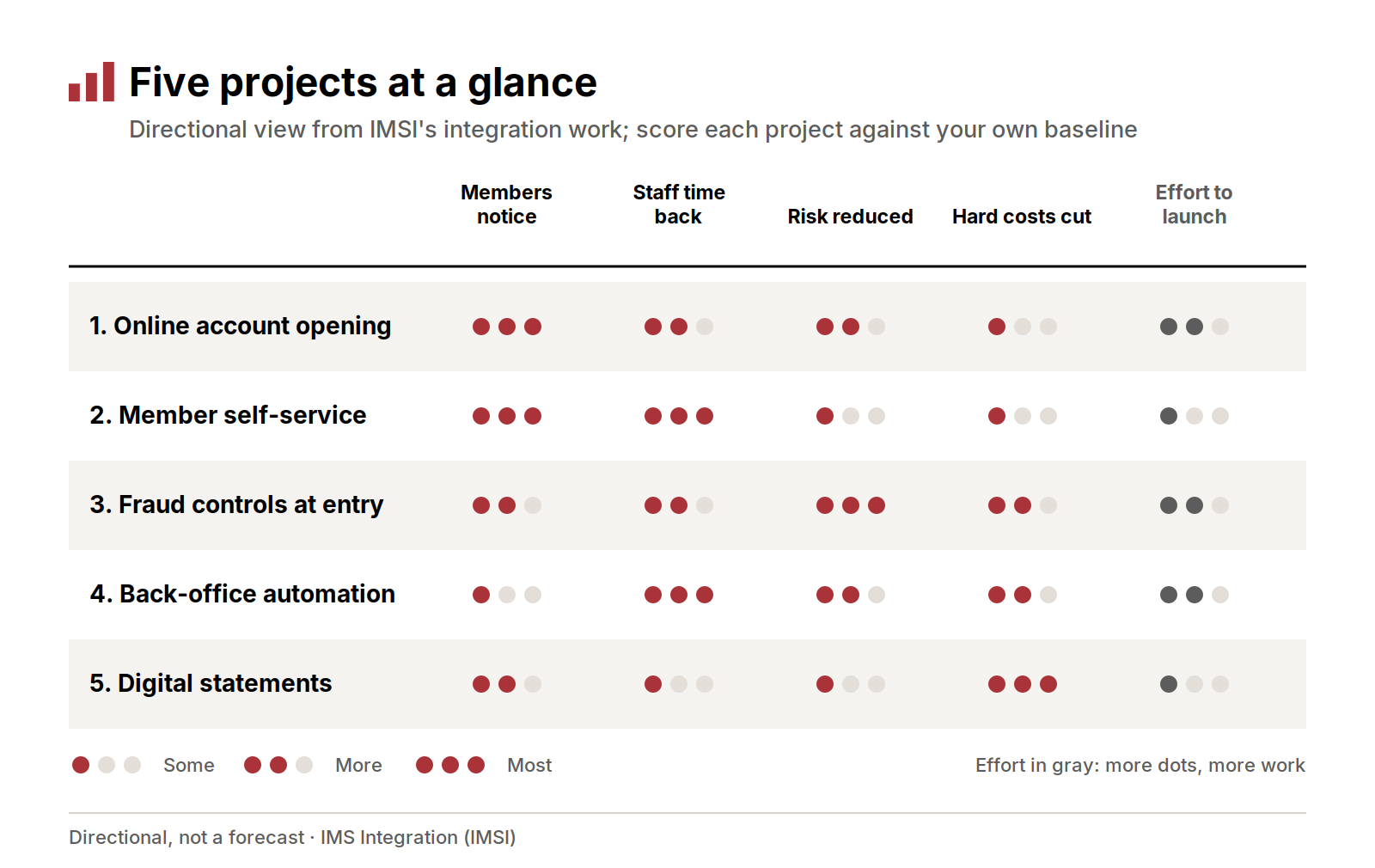
A directional comparison of the five projects: members notice self-service and account opening most, back-office automation returns the most staff time, and digital statements cut the most hard cost.
Then put each project on one page, so leadership compares them on the same terms: the project, the problem, a baseline, a target, one-time and annual costs, staff hours returned, and an owner with a decision date.
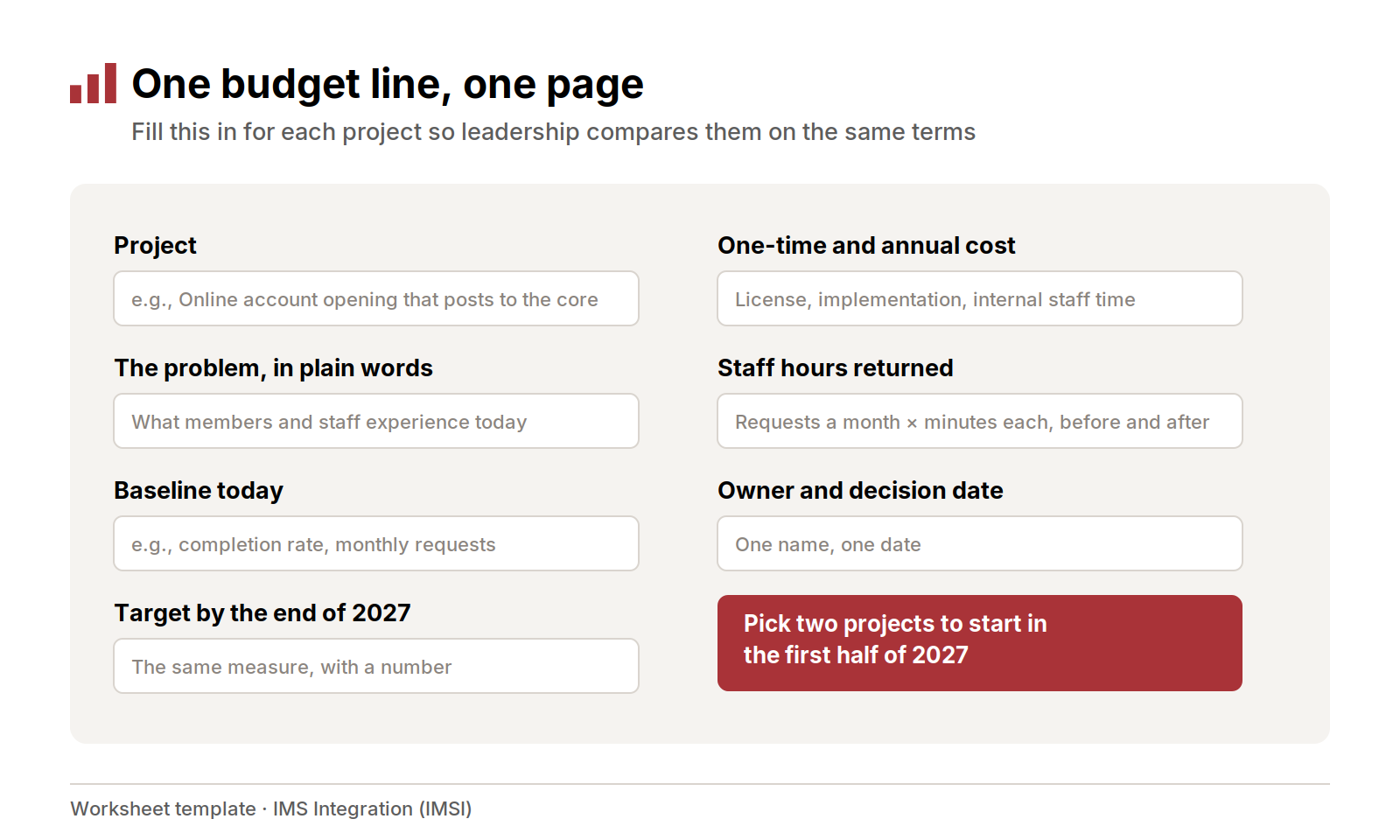
One page per project, with the same seven fields for every request.
Finally, pick two projects to start in the first half of 2027. Two is enough to show results within the year without stretching staff across too many launches at once.
Project 1: Online Account Opening That Members Finish
Digital account opening is now a meaningful share of growth, but most applicants never finish. Cornerstone Advisors’ 2026 Digital Banking Performance Metrics, a study of nearly 150 banks and credit unions, found that digital opening reached 27% of checking account openings in 2025, but 3.36 applications were abandoned for every one completed (Cornerstone Advisors).
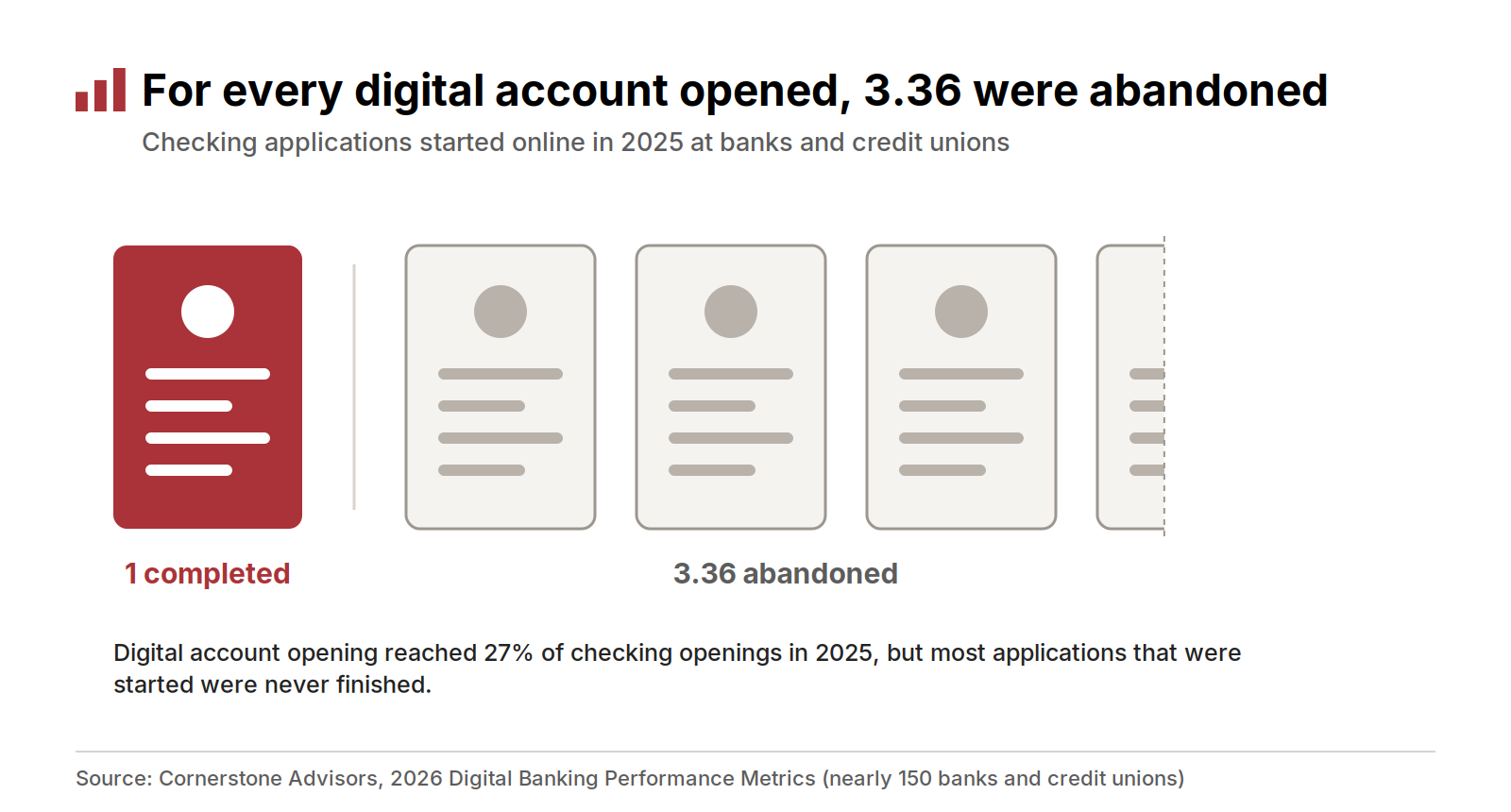
For every digital checking account opened in 2025, 3.36 applications were abandoned.
That ratio is a budget case on its own. You’ve already paid to attract those applicants. The project is to help more of them finish.
What to fund:
- A shorter path. Ask only what you need, in the order members expect, and save progress so they can come back.
- Checks inside the flow. Identity checks and funding should happen while the applicant is still there, not days later by email.
- Real-time core creation. The membership and accounts should exist in the core when the applicant sees “welcome,” so they can use them right away.
- Measurement by step. Track where applicants stop, so next year’s budget fixes the right screen.
For existing members opening a new account, prefilling what the core already knows removes much of the friction.
Project 2: Self-Service for Everyday Member Requests
Members already expect to handle routine requests on their phone. In the American Bankers Association’s 2025 survey, 54% of U.S. adults said a mobile app was their preferred way to bank; only 9% preferred a branch (ABA, November 17, 2025).
Yet many everyday requests still end in a phone call, an email, or a paper form: skipping a loan payment, making a loan payment, updating an address, reporting travel, adding a joint owner. Each one is small. Together they fill queues.
What to fund:
- Start with volume. Count the requests your staff handle by type for one month. The top three are your first phase.
- Make each request post to the core. A web form that emails staff just moves the work to a new inbox.
- Keep the sensitive ones secure. Address and contact changes deserve step-up verification, because they’re a common first move in account takeover.
- Tell members it exists. Put links where members already bank, and train the front line to point members to them.
This project usually shows results quickly, because the requests and the staff time are easy to count before and after.
Project 3: Fraud Controls at the Point of Entry
Fraud is now a line item on its own. Cornerstone’s 2026 study found that about half of credit unions had higher fraud losses in 2025, first-party fraud now makes up more than 40% of fraud losses, and three-quarters of institutions plan to increase fraud prevention budgets (Cornerstone Advisors, January 29, 2026). Consumers reported losing $15.9 billion to fraud in 2025, according to the Federal Trade Commission (FTC testimony, March 25, 2026).
It costs less to stop a bad account before it exists than after. What to fund:
- Identity checks inside the application. Identity verification (IDV), ID scanning, know your customer (KYC), and customer due diligence (CDD) should run while the applicant is in the flow.
- Rules that match your risk policy. Step up verification when signals look wrong, instead of adding friction for every applicant.
- A clear exception path. Flagged applications should land in one queue with the evidence attached and a record of every decision.
Be realistic about scope. Controls at entry reduce risk; they don’t catch everything. First-party fraud, where the member is real, often shows up only after the account is open, so budget for monitoring as well as entry checks.
Project 4: Back-Office Automation That Ends Re-Keying
Re-keying hides in plain sight: applications that arrive as emails or PDFs, forms staff copy into the core, reports assembled by hand each month. Nobody budgets for it, because it looks like normal work.
It matters more now because of AI. Cornerstone found that 59% of credit unions have deployed generative AI (Cornerstone Advisors, January 29, 2026). Those tools can only work with data they can reach. If staff still carry information between systems by hand, the data is scattered and the AI projects stall.
What to fund:
- An inventory. List every workflow where staff type information that already exists somewhere else.
- A simple calculation. Multiply requests per month by minutes per request. A task that takes six minutes and happens 400 times a month is 40 hours of staff time, every month.
- Automation that writes to the core. Rules-based workflows should validate data at entry, post it to the core, and route only exceptions to people.
Start with the workflows that are high in volume and low in judgment. They return time quickly and carry less risk.
Project 5: Statements and Digital Documents
Paper keeps getting more expensive. The U.S. Postal Service raised the Forever stamp from 78 to 82 cents and metered letters from 74 to 78 cents on July 12, 2026 (USPS, April 9, 2026). Every statement and notice you mail costs more than it did a year ago.
What to fund:
- Statements members can read. Clear digital statements make paperless enrollment an easy yes.
- Enrollment at every touchpoint. Offer e-delivery during account opening and in digital banking, not just once a year.
- Fewer third-party reformatting steps. In some setups, statement files leave the core and pass through outside vendors that reformat them, sometimes for a fee, before members see them. Each hand-off adds cost, time, and another place for errors.
- Notices, too. Loan, deposit, and account notices often follow the same path as statements. Moving them online at the same time adds to the savings.
This project is simple to measure in dollars: mailed statements a month, times postage and print, before and after.
How IMSI Helps
IMS Integration (IMSI) builds solutions for all five projects, and every one reads from and writes to the core. We offer 17 solutions on Corelation KeyStone and nine on Jack Henry Symitar (formerly Episys), all running on one workflow engine, Workbox.
| Project | IMSI solutions | Cores |
|---|---|---|
| Online account opening | Online Account Opening, AppFlow Account | KeyStone and Symitar |
| Online account opening | Click-to-Fund | KeyStone |
| Member self-service | Skip-a-Pay, Loan Payment | KeyStone and Symitar |
| Member self-service | Travel Notification, Member Info Updater, Add Joint | KeyStone |
| Fraud controls at entry | IDV, ID scanning, KYC, and CDD, built into every application | KeyStone and Symitar |
| Back-office automation | Workbox Messaging Center, Trial Balance | KeyStone and Symitar |
| Back-office automation | Infuzion for KeyStone API | KeyStone |
| Statements and documents | Make-a-Statement | KeyStone, Symitar, and other cores |
A few things matter when you’re budgeting for more than one of these:
- One workflow engine. Because every IMSI solution runs on Workbox, the second and third projects build on the first. Applications and requests arrive validated in one Workbox queue, whether it’s an account application, a skipped payment, or an address change.
- Your digital banking stays. Our solutions work alongside your existing online and mobile banking provider, so none of these projects forces a platform change.
- Configured to you. Each deployment is configured to your products, rules, and brand.
- A baseline before a budget. In a strategy call, we can walk through your current volumes and workflows with your team, so your budget request starts from real numbers.
IMSI has been founder-led since 2007 and serves hundreds of credit unions. When you call, you reach the people who built what you’re running.
Frequently Asked Questions
What technology should credit unions prioritize in 2027? Projects that tie directly to member growth, staff capacity, and fraud losses. Online account opening, member self-service, fraud controls at entry, back-office automation, and digital statements all qualify, and each can be measured before and after.
How do we compare projects with very different benefits? Put each on one page with the same fields: the problem, a baseline, a target, one-time and annual cost, staff hours returned, and an owner. Then compare side by side.
Do these projects require replacing our core? No. Each one extends the core you already run by reading from and writing to it directly.
Want help sizing these for your credit union? Schedule a strategy call
Related reading
- Modernizing Credit Union Technology Without Replacing the Core
- Enhancing Digital Account Opening Through Core Integration
- Taking Control of Statement Costs
Carlos Fulcher is co-founder and Chief Executive Officer of IMS Integration (IMSI), where he leads the company’s work with credit unions on KeyStone and Symitar. He brings more than 25 years of experience leading technology organizations and holds a BS in Industrial Technology and an MBA.